The coffee boom had structural limits.
Coffee exports exposed deeper limits.
In December 1928, thousands of banana workers gathered in Ciénaga on Colombia’s Caribbean coast. They demanded written contracts, cash wages, and basic legal protections. Within weeks, troops opened fire.
That confrontation exposed a deeper paradox in Colombia’s development between 1905 and 1929. The country recorded one of the fastest growth episodes in Latin America. Coffee exports boomed, railways spread, foreign capital entered, and national institutions took shape. However, many Colombians remained outside the gains.
The central question is not why Colombia grew. The harder question is why rapid growth produced only limited structural transformation. This blog traces what changed, why growth accelerated, what the state built, and why the boom still left Colombia dependent on coffee.
The boom changed output and institutions.
The transformation was real. After the Thousand Days’ War, Colombia entered a period of faster economic expansion. Per capita gross domestic product (GDP) growth rose from about 2.93 percent a year in 1905-1919 to 4.63 percent in 1920-1929. Between 1923 and 1928, overall GDP growth reached about 8.5 percent a year.
Coffee exports stood at the center of that expansion. Its share of exports rose from about 31 percent in 1910 to nearly 79.8 percent by 1924. Rising external demand generated foreign exchange, raised incomes in coffee regions, and strengthened Colombia’s external position.
The physical economy changed as well. Railway networks expanded from about 1,500 kilometers in 1923 to nearly 2,600 kilometers by 1929. New firms appeared in textiles, cement, and manufacturing. Coltejer, Fabricato, and Cemento Samper became visible symbols of a more diversified economy.
The state also changed. In 1923, Colombia created the Banco de la República, the Comptroller General, and the Banking Superintendency. In 1924, it created the Banco Agricola Hipotecario (Agricultural Mortgage Bank). These institutions gave the state new tools to manage money, supervise banks, audit spending, and channel agricultural credit.
Yet continuity remained strong beneath those shifts. Agriculture still dominated employment. Manufacturing still employed only a small share of workers. Coffee still organized much of the economy. Colombia became richer, but it did not decisively escape dependence on a narrow export base.
Political peace lowered investment risk.
Three forces drove the expansion. The first was political stabilization. After the Thousand Days’ War, Colombia replaced majoritarian rule with the “incomplete vote,” which guaranteed minority representation. Political conflict did not disappear. However, civil war ceased to be the primary means of settling it. That reduced political risk and made long-term investment more credible.
The second force was institutional modernization. The reforms associated with Edwin Kemmerer’s mission created a new financial architecture. The Banco de la República imposed monetary discipline. The Comptroller General strengthened fiscal oversight. The Banking Superintendency supervised commercial and mortgage banks. Together, these institutions reduced uncertainty and improved credibility with domestic and foreign investors.
The third force was external opportunity. Coffee prices rose during the 1920s. The United States paid Colombia a US$25 million indemnity after the Panama dispute. Wall Street lenders also became more willing to provide capital. By 1929, Colombia’s external debt had reached about US$257 million.
The timing matters. Colombia’s fastest growth coincided with rising coffee prices, indemnity flows, and foreign lending. Any explanation that focuses only on state capacity misses that overlap.
A different interpretation is more limited and more convincing. Institutions did not create the boom on their own. They helped Colombia organize it based on coffee exports. Political stabilization lowered risk. Financial institutions increased credibility. Those changes allowed Colombia to turn coffee revenues and foreign borrowing into investment rather than renewed instability.
The state coordinated rather than owned.
The state’s most important contribution was not ownership. It was coordination.
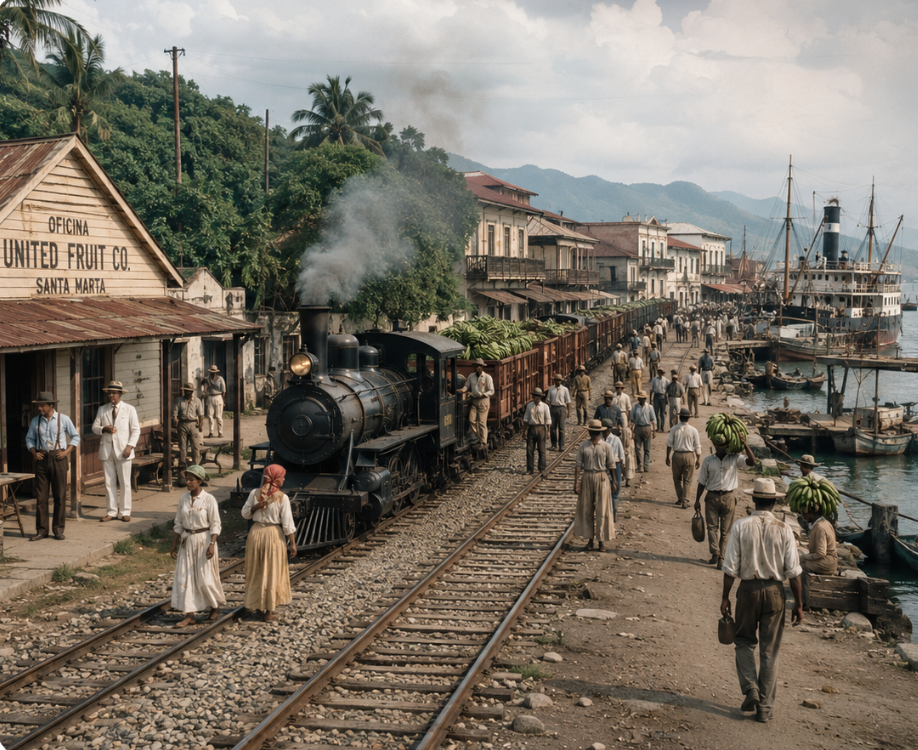
Railway expansion shows the mechanism clearly. Colombia’s geography fragmented markets and raised transport costs. Coffee regions in the interior faced costly and unreliable access to ports. Railway investment reduced those costs, connected producers to export corridors, widened market access, and raised the value of productive land.
The state directed major resources toward that objective. About US$16 million of Panama indemnity funds and a large share of foreign borrowing went into railway construction. Infrastructure became the main channel through which external resources changed economic incentives.
Financial institutions played a similar role. The Banco Agricola Hipotecario expanded long-term agricultural credit. The Banco de la República strengthened monetary stability. Banking supervision reduced systemic risk. Fiscal oversight improved confidence in public finances.
The state also accepted substantial risk. National and regional governments borrowed heavily abroad to finance infrastructure. Policymakers effectively wagered that future growth would justify current debt. During the 1920s, that wager appeared to work.
Industrial upgrading lacked state support.
Yet the state’s intervention had clear limits. Colombia developed institutions that could manage money, supervise banks, and finance infrastructure. The evidence is much weaker for institutions designed to accelerate industrial upgrading.
Manufacturing emerged, but it did not displace coffee exports as the organizing sector. Firms such as Coltejer and Fabricato showed that industrialization was possible. However, Colombia did not build an equivalent institutional architecture for diversification. The dossier shows new institutions for banking, auditing, and agricultural credit. It does not show a comparable system for directed industrial transformation.
That absence matters. Early manufacturing relied largely on private capital, retained earnings, and commercial networks rather than on a systematic state strategy. The boom, therefore, widened output and investment without creating equally strong mechanisms for productive upgrading.
Coffee concentrated gains and blocked diffusion.
The most revealing question is not why Colombia grew. It is what Colombia built during the boom. The answer was not a diversified industrial economy.
Coffee exports generated foreign exchange, investment, and demand. It also reinforced dependence on a narrow export structure. The evidence points to Dutch Disease pressures, in which booming coffee earnings appreciated the real exchange rate and weakened manufacturing competitiveness. The evidence also points to educational crowding-out, as coffee production raised the opportunity cost of schooling and kept labor in agriculture rather than industry.
Those effects reached beyond the factory floor. In coffee regions with high land inequality, local elites blocked school expansion to preserve a cheap labor force. As a result, counties tied more heavily to coffee developed fewer schools per capita than non-coffee counties.
Ciénaga revealed the social boundary of growth.
In the Magdalena banana zone, the United Fruit Company (UFC) built a large enclave economy around export agriculture. By 1928, about 30,000 laborers worked in the banana zone under an indirect hiring system. UFC used subcontractors to avoid Colombian labor laws. Workers often received coupons rather than cash, and those coupons tied them to company stores.
In November 1928, around 25,000 workers struck. They demanded an end to indirect hiring, an eight-hour day, compensation for workplace injuries, access to hospitals, decent dormitories, higher wages for the lowest earners, and the abolition of the coupon system. Instead of mediating, the Colombian state militarized the zone. On December 6, 1928, troops opened fire on a gathering of workers in Ciénaga.
The contrast is instructive. Colombia built institutions capable of managing growth. It proved far less capable of building institutions capable of broadening its benefits. The same state that reduced investor risk and expanded infrastructure did not secure basic protections for workers in one of the country’s major export enclaves.
The region still faces similar trade-offs.
What does this episode mean for Latin America and the Caribbean? The first lesson concerns constraints. Colombia did not remove geographic fragmentation. It reduced some of its economic effects through infrastructure.
The second lesson concerns coalition-building. Political stabilization came before the fastest growth. The incomplete-vote system mattered because it reduced incentives for violent conflict and made investment more predictable.
The third lesson concerns capability. Colombia’s most durable achievements were specific institutions performing specific tasks. The Banco de la República, the Comptroller General, and the Banking Superintendency endured because they solved identifiable problems.
The fourth lesson concerns sequencing. Colombia’s trajectory followed a recognizable order: political settlement, institutional consolidation, external opportunity, infrastructure investment, and then rapid growth. Reversing that sequence would likely have produced a different outcome.
The final lesson concerns trade-offs. Colombia built financial and administrative institutions. It captured a commodity and capital boom. It did not build equally strong institutions for productive transformation or social inclusion.
That distinction explains why Ciénaga matters. Growth and transformation are not the same thing. Colombia emerged from the 1920s with stronger institutions, more infrastructure, and higher incomes. It also remained heavily dependent on coffee, regionally uneven, and socially exclusionary.
The boom built a state capable of managing expansion. It did not build an economy capable of moving decisively beyond it.


Leave a Reply