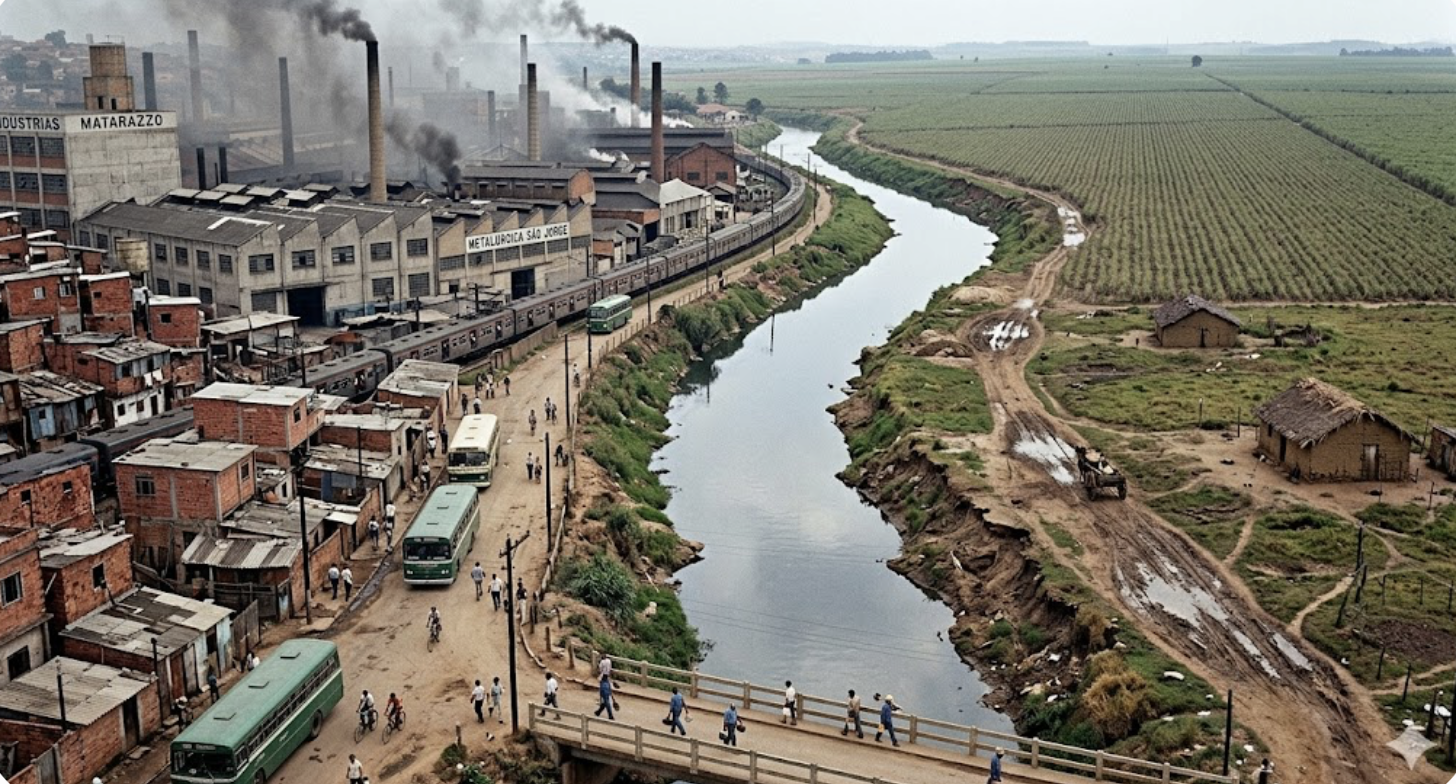
Growth without land reform.
Brazil built its industry on weak foundations.
Latin American policymakers still face a hard question: how do you build industry when land, skills, and capital stay trapped in low-productivity systems? Brazil faced that question after 1945. It pushed industry forward while leaving agrarian structures largely untouched.
The central constraint was political, not technical. The state needed the support of landowning elites, so land reform and broad skill formation did not happen. Instead, it redirected capital and labor into urban industry and protected selected sectors from competition. That produced fast industrial growth on weak social foundations. It also stored up instability and inequality. This post explains what changed, what drove it, and what the state did.
Industry grew, but the base stayed narrow.
Capital moved into a few industrial hubs.
Between 1945 and 1964, Brazil rapidly expanded its manufacturing capacity. But it concentrated that capacity in a narrow industrial core. São Paulo, Rio de Janeiro, and Belo Horizonte absorbed most new investment, while peripheral regions supplied raw materials and labor.
Urban growth showed the scale of the shift. São Paulo grew from 2.65 million people in 1950 to 4.74 million in 1960, as rural migrants moved into the industrial core. Financial policy reinforced that concentration. The state used multiple exchange rates to tax agricultural exporters implicitly and channel resources into industry. After 1955, foreign direct investment also rose sharply, bringing nearly US$500 million in capital goods after rule changes allowed machinery imports without foreign-exchange cover.
Human capital grew in volume, but not in quality. Migration expanded the urban labor pool, but capital-intensive industry could not absorb it into formal work. Brazil repeated an older pattern. It built an industrial base without broad skill formation and without agricultural reform.
Rules changed to protect urban industry.
Brazil built a more complex regulatory and financial system to support industrial expansion. The state tightened import licensing and used multiple exchange rates to direct capital and shield domestic firms. It also expanded labor rules under the Consolidation of Labor Laws (CLT), which gave formal protections to urban workers but excluded rural workers.
Firms also changed. Brazil developed a three-part system of state-owned firms, domestic private firms, and foreign multinationals that entered through regulated channels. New technocratic bodies, including the National Bank for Economic Development (BNDE), coordinated long-term investment and planning.
Yet the main institutional gaps stayed in place. Land tenure barely changed, and primary education remained badly underfunded, leaving more than half the adult population illiterate. These failings consolidated the period’s core pattern. Industry moved ahead, while agriculture and human capital lagged.
Urban growth deepened old social divides.
Urban industry gained power, but society stayed deeply segmented. Rural populations moved to cities and often ended up in informal work, which expanded favelas and structural underemployment. Regional inequality also widened. The Northeast became more dependent on the Center-South, buying high-cost industrial goods while exporting labor.
Political coalitions kept this system in place. The government protected its alliance with landowners by avoiding land reform and by keeping rural workers outside formal protections. Urban workers, by contrast, received selective benefits. So the labor regime became more segmented.
Macroeconomic strains then grew. The Plano de Metas delivered rapid expansion, but it also drove debt and inflation upward, with inflation above 40 percent a year. By 1964, the system had run into a political and economic crisis. The limits of industrialization without structural reform were exposed.
State choices drove the pattern of change.
The state created new industrial actors.
Industrial expansion created a wide range of firms and sectors, but the state drove that variation. The government created new actors, including state-owned firms such as Petrobras, CSN, and Vale, in capital-intensive sectors where private investors would not act. It also established specialized bodies, such as GEIA, to build new industries, including automotive manufacturing.
The new state industries produced a mixed industrial structure comprising state, domestic, and foreign firms. Technologies, production systems, and sectoral strategies became more varied. But the political setting stayed narrow. The state did not allow similar changes in land ownership or rural organization, so industrial experimentation expanded while agrarian institutions stayed fixed.
Protection favored industry over productivity.
Selection pressures strongly favored industry, but they did not impose much productivity discipline. Tariffs, import licensing, and exchange rate controls made industrial investment profitable and pushed capital out of agriculture and into manufacturing. The multiple exchange rate system was central to that shift.
Finance then weakened discipline. BNDE offered long-term loans at below-market rates, which reduced capital costs for large firms without requiring efficiency gains. So, selection rewarded access to state-backed finance and political connections more than productivity.
Labor selection was weak as well. Industrial firms drew on abundant, low-cost migrant labor, while rural workers stayed outside legal protections. That reinforced a dual labor market shaped by industrialization without agricultural reform.
Technology spread, but only in enclaves.
Technology and managerial knowledge spread quickly, but through narrow channels. Foreign direct investment brought in advanced machinery, factory layouts, and production systems. BNDE’s technocratic networks also spread common methods for project appraisal and planning.
That diffusion was highly uneven. Industrial capabilities stayed concentrated in the Center-South, while peripheral regions had limited access to these flows. Workers moved across cities, but weak education systems limited the transfer of skills.
The result was an enclave pattern. Technology spread within industrial hubs, but it did not transform the wider economy. Once again, industry advanced without parallel agricultural reform or investment in human capital, so system-wide productivity gains remained limited.
The state directed capital and protected allies.
The state chose industry over rural reform.
The Brazilian state set a clear direction: rapid industrialization through import substitution. It built a political coalition that linked industrial interests with rural elites. That alliance preserved short-term stability, but it also blocked land reform.
The state then shaped markets directly. Exchange rate policy, import licensing, and tariffs redirected capital from agriculture into industry. SUMOC Instruction 113 also eased foreign entry by allowing machinery imports without foreign-exchange constraints. These tools made industrial investment attractive while squeezing alternatives.
Public investment created industry, not skills.
The state became the main investor in infrastructure and heavy industry. It created BNDE to mobilize long-term capital and finance transport, energy, and basic industry. It also built large state-owned firms into which private capital would not flow.
These investments expanded industry and infrastructure, especially under the Plano de Metas. But the same push neglected key social sectors. Primary education remained underfunded, rural services stayed weak, and social protection remained tied to formal urban work. That deepened labor segmentation and limited long-term productivity growth.
Technocrats adapted, but core reforms stalled.
The state showed real adaptive capacity in selected domains. Technocratic enclaves such as BNDE and sectoral planning bodies could take decisions with some distance from clientelist pressure. The state also tested regional strategies, including SUDENE’s structuralist planning for the Northeast.
But broader governance remained weak. Brazil lacked a centralized monetary authority, so credit expansion stayed exposed to political pressure. The state financed growth through inflation and regressive taxation, which fed macroeconomic instability.
The biggest limits came from decisions not taken. The state chose not to redistribute land and failed to build a strong education system. That preserved the ruling coalition, but it also locked in structural constraints. Industry moved ahead, while the social base beneath it stayed weak.
Brazil’s experience still carries hard lessons.
Three constraints still shape policy choices.
Brazil’s experience points to three hard constraints that still matter for Latin American and Caribbean policymakers.
First, shifting capital can speed industrial growth, but it creates a structural imbalance if other productive systems are bypassed. Brazil redirected finance effectively, yet the rural economy remained stagnant and extractive. Sequencing matters. Industrial policy cannot replace agrarian reform when land systems distort resource allocation.
Second, industrialization without investment in human capital imposes long-term limits on productivity. Brazil expanded factories faster than it expanded skills, producing dual labor markets and persistent informality. The system absorbed labor, but it did not upgrade it. That constraint still matters in economies facing rapid urbanization.
Third, policy-driven selection must balance protection with discipline. Brazil accelerated capital accumulation, but it weakened efficiency pressures. Protected firms will not upgrade productivity without clear performance requirements.
One choice ran through the whole period: Brazil built industry without agricultural reform. That choice shaped the opening push, the urban labor market, and the final crisis. It delivered short-term industrial gains, but it narrowed the country’s long-term path. For policymakers today, the bottom line is clear. If the state moves capital into industry while leaving land, skills, and rural services untouched, growth will rest on a weak base.


Leave a Reply