Export diversification changed markets before power.
Colombia broke dependence without broad inclusion.
Colombia changed its economic structure between 1958 and 1974, but it did not settle who gained and who lost. Manufacturing deepened, non-coffee exports rose, and internal markets became more connected. Decree-Law 444 of 1967 drove the turn by changing the arithmetic facing exporters.
The Colombian case matters because many countries across the region face the same problem today. A country can ease a binding constraint and still route gains through narrow channels. Colombia loosened the coffee and foreign-exchange constraint, but protected firms, large farms, and core regions captured most of the gains. This article explains how Colombia diversified, why the state mattered, and why distribution lagged structural change.
Structural change moved faster than distribution.
The first change was sectoral. Colombia’s real gross domestic product (GDP) grew 4.75 percent a year between 1950 and 1972. Agriculture’s share of gross national product fell from 35.9 percent in 1950 to 26.7 percent in 1972. Manufacturing rose from 16.2 percent of GDP in 1958 to 20.2 percent in 1972, peaking at 23.5 percent in 1974.
Industry also changed from within. Non-durable consumer goods fell from 64.2 percent of industrial output in 1958 to 52.9 percent in 1974. Durable consumer and intermediate goods rose from 30.5 percent to 38.5 percent. Capital goods rose from 5.3 percent to 8.6 percent.
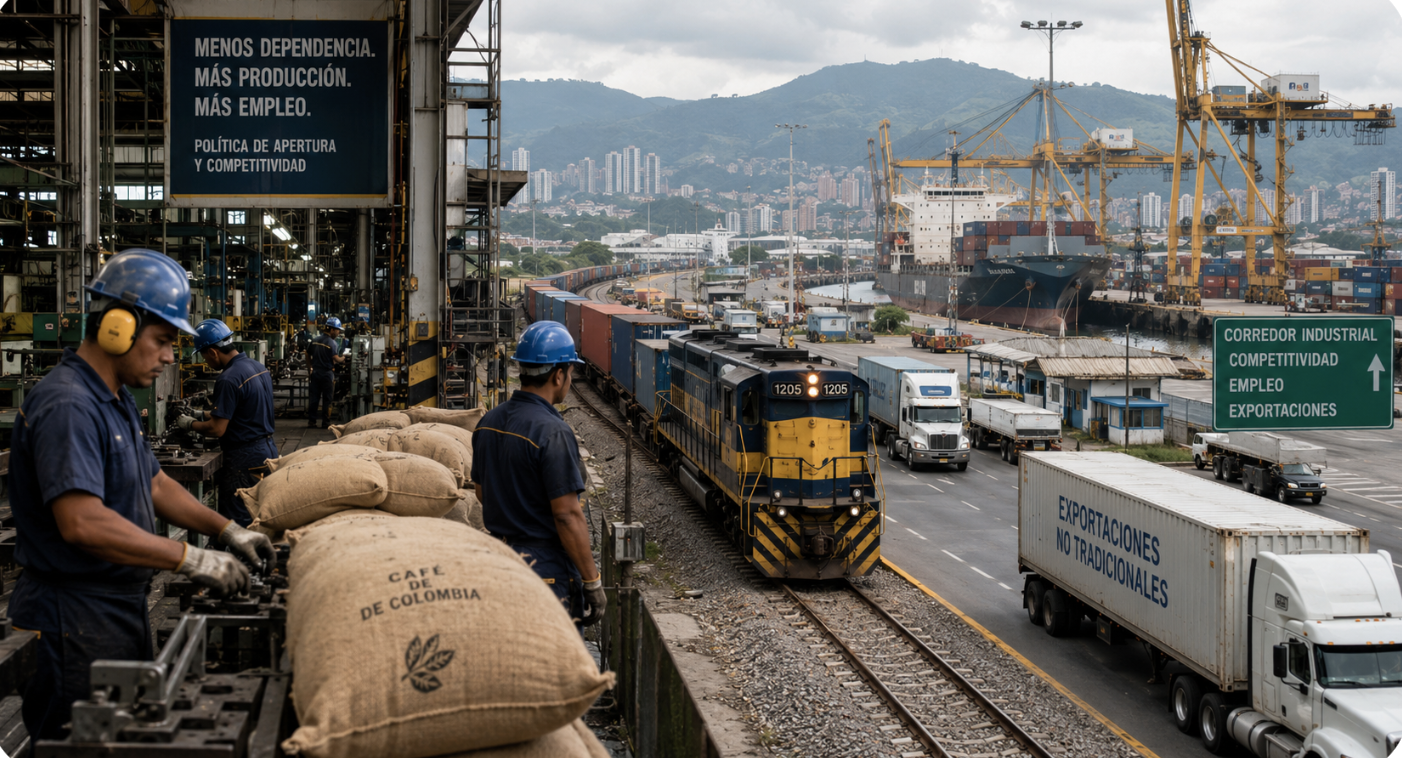
The second change was export diversification. Coffee fell from more than 80 percent of the merchandise export value in 1953/1954 to 50 percent in 1973. Minor exports rose from US$226 million in 1969 to US$890 million in 1974. Manufactured exports grew from less than 2 percent of total exports in 1960 to 15 percent in 1973.
The third change came through jobs and infrastructure. Agriculture and mining lost 284,485 jobs from 1964 to 1973. Manufacturing and utilities added 180,858 jobs, while services added 435,502 jobs. Installed generating capacity rose from 270 megawatts (MW) in 1950 to 2,330 MW in 1970.
Distribution did not follow the same path. Income inequality remained persistently high throughout the period. Regional concentration also persisted, though not mechanically. Bogota’s GDP per capita primacy fell from 2.3 times the national average in 1950 to 1.7 times in 1974. Yet the Bogota-Medellin-Cali core still anchored the national economy, and convergence remained weak. Industrial exports were also highly concentrated, with 24 firms handling 62 percent of the total in 1970.
The export channel was narrow because the production base was narrow. Large plants with more than 200 workers were only 4.1 percent of establishments but produced 61.8 percent of value added. The top 150 enterprises held 53.2 percent of manufacturing value added. Large-firm wages were about three times micro-firm wages.
Export incentives changed producer arithmetic.
The strongest explanation is not that Colombia invented manufacturing in 1967. The counterfactual is serious. Manufacturing production had already grown at an annual rate of 5.3 percent from 1954/1955 to 1966/1967, and officials attributed some export swings to world demand. That means Decree-Law 444 cannot be treated as a single-cause explanation. The stronger claim is that it redirected an existing industrial base toward minor and manufactured exports.
Coffee created the pressure for change. Mild arabica prices fell from 79.93 US cents per pound in 1954 to 39.55 US cents per pound in 1963. Colombia still depended heavily on coffee exports, so the price fall tightened the foreign-exchange constraint. The 1962 International Coffee Agreement added quotas and price floors. However, it did not produce the later export break.
External finance bought time but did not allocate the response. The Alliance for Progress committed US$761.9 million to Colombia between 1961 and 1969. World Bank files also record lending across agriculture, industry, and infrastructure. These flows relaxed the balance-of-payments constraint before the export policy bundle fully operated.
Decree-Law 444 changed five margins at once. The crawling peg adjusted the exchange rate daily or weekly through the Central Bank. Tax rebate certificates (CATs) paid 15 percent of the free-on-board (FOB) export value. The Vallejo Plan removed duties on imported inputs used for exports. The Export Promotion Fund (PROEXPO) supplied concessional credit. The Foreign Trade Institute (INCOMEX) rationed access to imports through prior licensing.
That package changed exporter arithmetic. The effective exchange rate for non-traditional exporters averaged 14.4 pesos per dollar. That meant a 60 percent real increase in export revenues relative to 1958-1966. The timing and composition then shifted. Manufacturing growth accelerated from the earlier 5.3 percent path to the 7.9 percent “golden age” rate, and manufactured exports grew 48 percent a year from 1967 to 1974.
The employment pattern gives the mechanism more force. Under import substitution before 1967, manufacturing output grew, but jobs barely followed. Manufacturing employment grew about 1 percent a year, and it recorded no net growth between 1962 and 1967 despite 5.5 percent output growth. After the 1967 export turn, manufacturing employment accelerated to roughly 3-4 percent per year.
The claim still needs a limit. Diaz-Alejandro cautioned that available information could not link each policy variable to each trade-account gain. The mechanism works best as a bundled explanation of timing, composition, and employment, not as a clean single-cause proof. Decree-Law 444 did not create industry from nothing. It shifted returns to exporting for firms that already had sufficient capability to respond.
State capacity built and bounded markets.
The state first shaped markets through prices and licenses. Decree-Law 444 made the Central Bank the active setter of the exchange-rate path. INCOMEX administered prior import licenses and foreign-exchange allocations. PROEXPO supplied credit and support exclusively to non-coffee exporters.
The state also built physical markets. The Atlantic Railway opened in 1961 and linked interior rail systems to Caribbean ports. The National Electrical Interconnection Company (ISA) connected municipal electricity systems into a national grid in the late 1960s. These investments reduced the fragmentation that private firms could not solve alone.
Public investment carried pioneer risks. The Industrial Development Institute (IFI) invested in steel, petrochemicals, and heavy machinery. The Colombian Petroleum Company (ECOPETROL) invested in oil and refining on a scale private investors would not fund. Paz del Rio represented the steel bet, but it also exposed the weak discipline behind some of the government’s risk-taking.
Adaptive governance was real, but it moved. At the start of the period, coherence was low. The Alberto Lleras Camargo administration pursued incompatible goals simultaneously: import liberalisation, rigid foreign-exchange controls, and a suppressed coffee exchange rate. The 1961-1970 Plan Decenal was quietly ignored. A 1962 World Bank mission warned that uncoordinated public-sector policies were crippling implementation.
Coherence then rose under Carlos Lleras Restrepo. The National Planning Department (DNP), the National Council for Economic and Social Policy (CONPES), the National Monetary Board, and the export policy agencies gave Colombia a more aligned policy framework. Price, tax, input, credit, and licensing instruments moved together during the 1967-1972 export-diversification push.
That is why the Colombian case is useful. It shows coherence rising from an incoherent 1958 starting point into a more disciplined 1967-1972 policy bundle. But coherence was not correctness. The Colombian Institute of Agrarian Reform (INCORA) pursued land reform while Currie’s large-scale agro-industry model pulled policy in another direction. IFI lacked planned exit rules and absorbed failing ventures. INCOMEX did not sunset when the original rationale for foreign-exchange rationing weakened.
The rural side shows the state at its strongest and its weakest. INCORA’s Sharecroppers and Tenants Program transferred Agricultural Family Units to landless sharecroppers and tenants. Recipients became 20 percentage points more likely to migrate, and their children completed 1.5 additional years of school. Elite agrarian resistance then choked off the path through Chicoral in 1972.
The exclusion was not only inefficient. It helped feed the next cycle of conflict. La Violencia had already killed more than 200,000 people, and the National Front stabilized elite politics by excluding other forces. Peasant mobilization through the National Association of Peasant Users (ANUC) in the 1970s exposed the unresolved land question. Chicoral and Law 4a of 1973 then entrenched the power of large landholders. The narrow channels of growth did more than limit distribution. They helped carry political violence forward.
Regional policy must trace capture channels.
The first lesson is constraint. Colombia did not begin with a general reform agenda. It faced coffee dependence, falling prices, foreign-exchange scarcity, and fragmented internal markets. The state sequenced around those constraints with coffee stabilization, exchange-rate management, and infrastructure connection.
The second lesson is coalition. The National Front stabilized Liberal-Conservative competition and protected a technocratic policy core. That bargain helped ministries and investors read the policy signal. It also excluded rivals and left land and regional power largely intact.
The third lesson is capability. Colombia had agencies that could implement instruments, not only announce them. The Central Bank managed the exchange rate, INCOMEX controlled access to imports, and PROEXPO moved credit. ISA, IFI, ECOPETROL, and the railways provided the hard infrastructure and financial base.
The fourth lesson is sequencing. The 1967 package worked because price, tax, input, credit, and license instruments moved together. A devaluation alone would not have lowered input costs. A credit line alone would not have changed the export price.
The fifth lesson is a trade-off. Colombia’s state-shaped channels produced diversification through large exporters, protected firms, and core regions. They did not automatically create shared prosperity. Decree-Law 444 solved one problem well, but its allocation channels narrowed who gained and helped leave exclusion politically unresolved.
That is a useful lesson for the region today. Do not ask whether the state should shape markets in the abstract. Ask which constraint it targets, which coalition it builds, which agency can implement the instrument, and who captures the channel after it works.


Leave a Reply