An earthquake opened the door.
From an export economy to an industrial system.
Between 1939 and 1955, Chile shifted from a vulnerable nitrate-and-copper export economy toward a state-coordinated industrial system built around electricity, steel, petroleum, and manufacturing. Markets alone did not drive the transformation. It emerged from a political and institutional response to a crisis. For Latin American and Caribbean policymakers today, the case matters because it shows how states build productive capacity when private finance will not, and how that effort fails when macroeconomic discipline lags.
The turning point came after the Chillán earthquake of January 1939. The disaster killed roughly 28,000 people, destroyed infrastructure across south-central Chile, and created a political opening for new state institutions. President Pedro Aguirre Cerda’s Popular Front government used the emergency to establish the Corporación de Fomento de la Producción, better known as CORFO. The institution became the center of Chile’s industrial strategy for the next decade and a half.
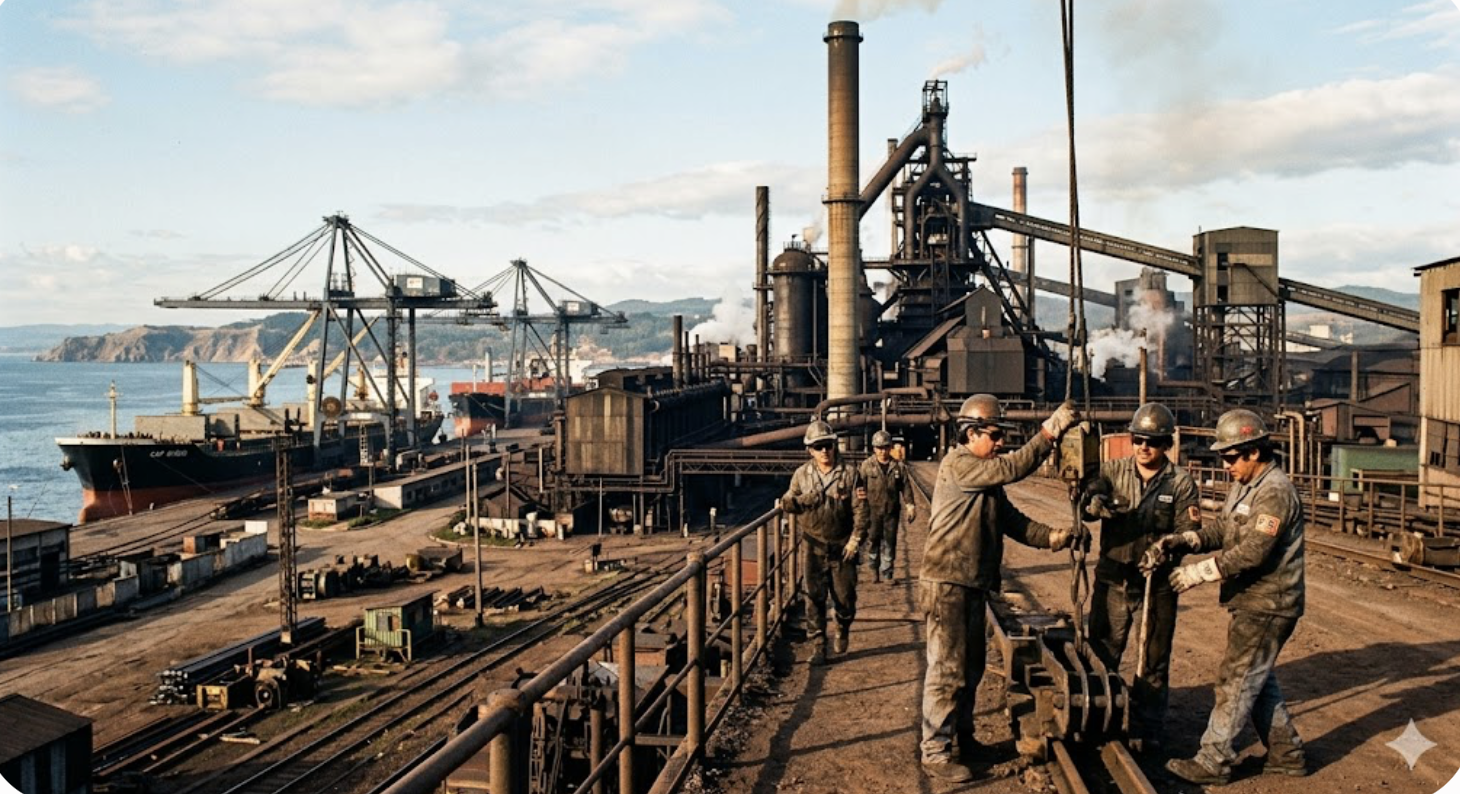
The CAP steel complex at Huachipato, near Talcahuano, anchored this shift. The project required foreign loans, state guarantees, engineering expertise, and long-term planning that private Chilean markets could not provide. Huachipato supplied steel to mining, construction, and metalworking, and it became the test case for whether the state could build the upstream sectors a modern economy required.
Manufacturing rises, agriculture stalls.
Output, structure, and the rise of CORFO.
Between 1939 and 1955, Chile moved away from a liberal export model centered on copper and nitrates toward a partially industrialized economy coordinated by the state. Manufacturing output grew far faster than the broader economy during the 1950s. Manufacturing expanded at an annual average rate of 8.14%, while aggregate GDP grew at 3.35%. Manufacturing’s share of GDP increased from roughly 20% in 1950 to about 25% by 1959.
The structure of production also deepened. By 1957, the domestic industry sourced 74.4% of its industrial raw materials locally. Local sourcing marked a shift away from dependence on imported consumer goods and toward domestic industrial linkages. Chile did not merely assemble imported products behind tariffs. It built upstream sectors supplying electricity, fuel, steel, and industrial inputs.
CORFO sat at the center of this process. Between 1939 and 1954, it controlled more than 30% of national investment in machinery and equipment, over 25% of public investment, and up to 18% of total gross domestic investment. The institution mobilized capital on a scale unavailable through private financial markets.
Strategic enterprises, labor shift, uneven gains.
The state also created a new generation of strategic enterprises. ENDESA, founded in 1944, led national electrification and expanded hydroelectric generation. CAP, founded in 1946, built the integrated steel mill at Huachipato. ENAP, created in 1950, expanded petroleum production and refining capacity. IANSA, founded in 1952, developed domestic sugar processing. These enterprises targeted structural bottlenecks rather than consumer industries alone.
Labor and administrative structures changed as well. Employment shifted away from agriculture and toward urban industry and construction. At the same time, the state expanded its technical and bureaucratic reach. Engineers from the University of Chile increasingly replaced traditional legal elites in economic administration. Public employment doubled between 1930 and 1957, while road density increased significantly during the 1940s.
Yet the transformation remained uneven. Agriculture stagnated even as manufacturing expanded. Between 1940 and 1954, Chile’s agricultural trade deficit increased nearly sixfold, turning the country into a structural food importer. Industrialization succeeded in some sectors while exposing new macroeconomic vulnerabilities.
Shocks, CORFO, and the technocratic turn.
The transformation emerged from the interaction of external shocks, political crisis, and institutional innovation. The Great Depression exposed the fragility of Chile’s nitrate-dependent export economy. World War II then restricted imports and disrupted access to foreign industrial goods. At the same time, the United States imposed a wartime copper price ceiling of 12 cents per pound, limiting Chile’s export earnings despite strong demand.
These shocks created pressure for domestic production, but scarcity alone did not build industrial capacity. The decisive mechanism was institutional coordination through CORFO. The earthquake allowed the government to overcome legislative resistance and establish permanent development institutions. Emergency reconstruction became long-term industrial planning.
The state deployed three connected policy instruments. First, it maintained an overvalued exchange rate that subsidized the import of industrial machinery. Second, it protected domestic firms through tariffs and import quotas. Third, it directed capital into high-risk sectors through public investment and state guarantees. Together, these mechanisms redirected foreign exchange and investment toward strategic industries.
CORFO mobilized capital that private markets could not.
Finance was central to the process. CORFO functioned simultaneously as a development bank, investor, guarantor, and foreign borrower. The institution combined copper revenues, fiscal transfers, and external loans to finance projects beyond the reach of domestic private capital. The CAP steel project illustrates this clearly. CORFO secured a landmark $28 million loan from the Export-Import Bank of Washington in 1945, absorbed exchange-rate risks, and financed local expenditures inside Chile.
The Huachipato steel plant reveals how the system operated. CAP was structured as a mixed public-private venture: 33% CORFO equity, 14% public debt participation, and 53% private shareholders. The project supplied steel bars, slabs, and industrial inputs directly to the mining, construction, and metalworking sectors. Industrial policy, therefore, focused less on isolated factories than on building production systems.
The model also depended on a new technocratic class. CORFO bypassed older legalistic administrative structures and elevated engineers into positions of economic coordination. This change mattered because the projects involved engineering design, infrastructure planning, debt management, and long-term industrial sequencing across multiple sectors.
The state is the builder, financier, and risk-bearer.
The Chilean state did not simply regulate markets during this period. It shaped markets directly. CORFO coordinated investment, absorbed risks, organized foreign borrowing, and built sectors that private firms considered too uncertain or capital-intensive.
ENDESA demonstrates this role clearly. The enterprise implemented the National Electrification Plan and expanded hydroelectric generation nationwide. Cheap electricity lowered production costs for private manufacturers and removed a major bottleneck to industrial growth. The state was therefore not entirely replacing markets. It was constructing the infrastructure that the markets required to expand.
The same logic applies to petroleum and sugar. ENAP reduced exposure to imported fuel shocks through domestic refining and exploration. IANSA attempted to reduce dependence on imported sugar while supporting rural production. These projects combined public finance, infrastructure, and industrial coordination.
The state also expanded administrative capability. CORFO operated with substantial autonomy and continuity across political administrations. Sectoral committees, engineers, and planning divisions coordinated investment decisions over long time horizons. However, the dossier does not provide detailed evidence on procurement systems or project appraisal procedures.
The model produced political and social trade-offs. Currency overvaluation and food-price controls supported urban industrialization but weakened agricultural incentives. The Caja de Crédito Agrario expanded subsidized agricultural lending, yet food imports continued to rise. Inflation increasingly transferred adjustment costs onto workers. By 1955, inflation reached 83.8%, while real wages declined sharply despite continued productivity growth.
The central contradiction was external. Industrialization required imports of machinery, fuel, and food, while Chile remained dependent on volatile copper exports for foreign exchange. When copper prices weakened in 1954, reserves collapsed, and the model entered crisis. The Klein-Saks stabilization mission of 1955 marked the end of the first high-momentum phase of CORFO-led industrialization.
What Latin America and the Caribbean can take from Chile.
Chile’s experience matters because it shows that industrialization depended on institutions capable of coordinating finance, infrastructure, and technological capability simultaneously. The core achievement was not protection alone. It was the ability to mobilize capital into sectors that private markets avoided.
The sequence also matters. Chile first targeted bottlenecks in electricity, steel, fuel, and industrial inputs before broader industrial expansion accelerated. Huachipato became important not because steel symbolized modernization, but because mining, construction, and manufacturing required a domestic steel supply to expand.
The case also highlights the limits of protection without macroeconomic balance. Chile built industrial capability, but copper remained the principal source of foreign exchange. Agricultural stagnation, food imports, inflation, and external dependence eventually constrained the model. The lesson is therefore not that all import-substitution industrialization fails. The lesson is that industrial protection without export capacity, agricultural productivity, and macroeconomic discipline creates structural fragilities.
For Latin America and the Caribbean today, the case suggests that state capability matters most during periods of technological and productive transition. Markets alone rarely finance long-horizon infrastructure, upstream industrial systems, or early-stage coordination under conditions of uncertainty. Yet Chile also demonstrates that successful industrialization requires mechanisms capable of disciplining inflation, managing foreign exchange, and adapting institutions as conditions change.


Leave a Reply