This index organises all research posts by theme and type, making it easy to navigate the evidence base for The Next Wave. Use the search bar below to find posts by keyword, or browse by category using the links.
Search all posts
Browse by category
📚 Research Case Studies
Historical and contemporary case studies that test the book’s framework against real-world evidence. Covers five centuries of technological revolutions, LAC commodity and industrialisation cases, small island economies, and international comparators from Korea to Germany.
🔬 Framework Essays
Conceptual posts that introduce and apply the book’s three analytical lenses: the Human Ecosystem Model, evolutionary economics (variation, selection, diffusion), and state-led transition theory. Start here if you are new to the book’s framework.
📋 Policy Briefs
Actionable posts for policymakers, mapping case study lessons to specific country types — from resource-rich large economies to small island states. Covers green transitions, digital transformation, industrial policy, and state capability building.
Browse by theme
Understanding the Framework
These Framework Essay posts introduce the book’s core analytical tools — evolutionary economics, the Human Ecosystem Model, and the five state functions for change — and explain the patterns of technological revolutions across history.
Five Historical Technological Waves (Chapter 5 evidence)
Posts on the five global revolutions: the First Industrial Revolution (Britain 1760–1830), the Age of Railways and Steam (1820–1880), Steel, Electricity and Telephone (1870–1920), Cars, Planes and Mass Production (1920–1970), and the Digital Revolution (1970–2020). Also includes a summary post on 300 years of revolutions and a forward-looking post on 2020–2070.
LAC Success Cases (Chapter 6 evidence)
Posts on cases where LAC countries built new capabilities or made successful transitions: Costa Rica’s distinctive development trajectory (1950–2010, including the Intel story), Uruguay’s energy transition (2010–2024), Chile’s renewable leap, Brazil’s renewable transformation, Mexico’s mobile leapfrog, and more.
LAC Challenges and Missed Opportunities (Chapter 7 evidence)
Posts on cases where resource endowments failed to deliver transformation: Peru’s guano and Chile’s nitrates, Venezuela’s oil boom, Ecuador and Trinidad oil cases, Brazil’s rubber vs. coffee contrast, Mexico under Díaz, Argentina’s export boom and its limits, and multiple Caribbean and Central American cases.
International Comparators
Non-LAC case studies that illuminate the book’s framework through contrast and comparison: Taiwan and Korea’s industrial miracle, Japan’s savings-led growth and land-tax industrialisation, Germany’s industrial rise and post-war recovery, Britain’s early industrialisation cycles, Estonia’s digital state, Norway’s EV transition, Denmark’s renewable shift, and China’s rapid scaling.
State Strategy and Getting Started (Chapters 9–11 evidence)
Posts on how states can build capabilities and manage transitions: the five state functions for institutional change, Chile’s copper and salmon sectors, Brazil’s Cerrado model, forestry institutions, green transition strategies, and digital transformation case studies.
All posts
-
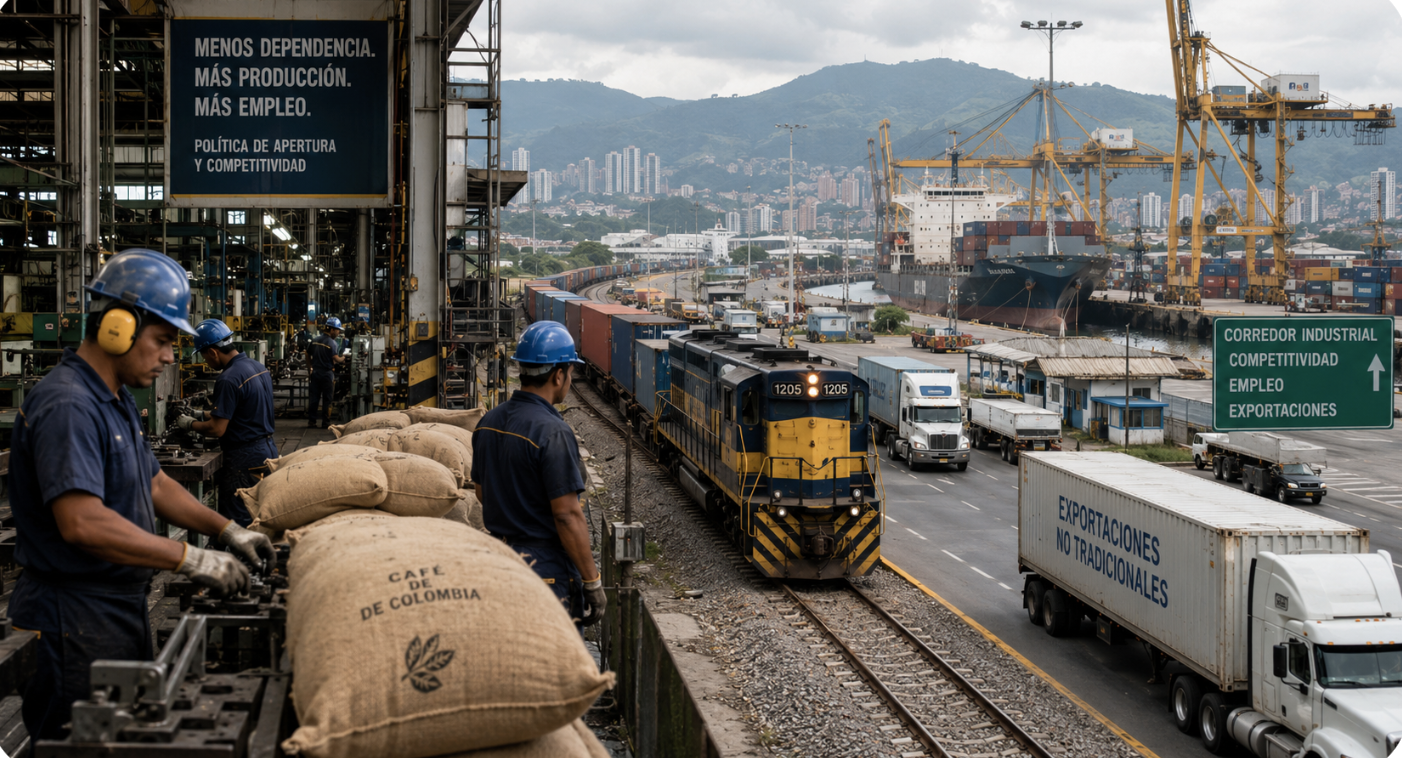
From 1958 to 1974, Colombia diversified away from coffee, but gains were slow to materialize.
Export diversification changed markets before power. Colombia broke dependence without broad inclusion. Colombia changed its economic structure between 1958 and 1974, but it did not settle who gained and who lost. Manufacturing deepened, non-coffee exports rose, and internal markets became more connected. Decree-Law 444 of 1967 drove the turn by changing the arithmetic facing exporters.…
-
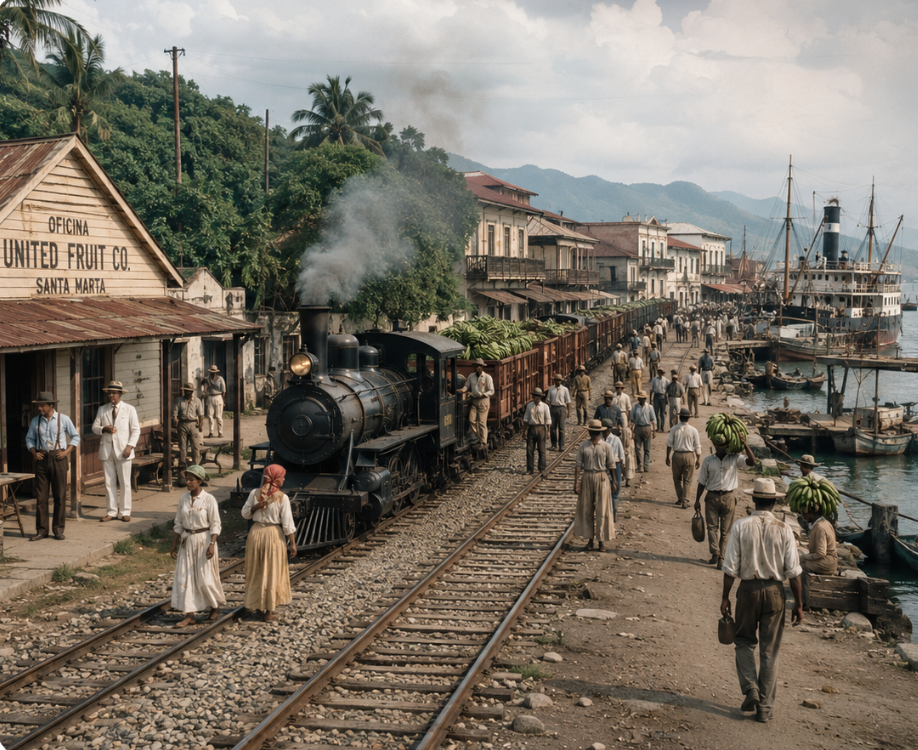
Colombia Grew from 1905 to 1929 Without a Deep Transformation.
The coffee boom had structural limits. Coffee exports exposed deeper limits. In December 1928, thousands of banana workers gathered in Ciénaga on Colombia’s Caribbean coast. They demanded written contracts, cash wages, and basic legal protections. Within weeks, troops opened fire. That confrontation exposed a deeper paradox in Colombia’s development between 1905 and 1929. The country…
-
Ecuador’s banana boom spread gains, not power.
Independent growers replaced the enclave. An external shock opened Ecuador’s banana market. Ecuador changed sharply between 1948 and 1965. An external shock opened a banana market that the country had not planned to dominate. By 1952, Ecuador was the world’s top banana exporter. The boom changed land use, migration, cities, and class structure. This blog…
-
Ecuador’s 1880-1920 Cacao Boom Built a Captive State.
How a commodity boom inherited and armed a fragile state A bank turned an export collapse into a massacre. In November 1922, soldiers fired into an unarmed crowd in Guayaquil and threw bodies into the Guayas River. Four decades earlier, Ecuador had ridden one of the world’s largest cacao booms. The same boom that financed…
-
Argentina, from 1989 to 2001: Stability Created the Conditions for Collapse.
Argentina’s anti-inflation regime amplified systemic fragility. Collapse Exposed the Hidden Logic. In December 2001, Argentines found their savings frozen, crowds filled the streets banging pots and pans, and President Fernando de la Rua left the Casa Rosada by helicopter. Five presidents followed in rapid succession. Eighteen months earlier, international institutions still praised Argentina as a…
-
Uruguay Grew Between 1870 and 1913, but Stayed Narrow.
An export boom hit hard limits. An export boom brought wealth but not breadth. Uruguay changed dramatically between the 1870s and 1913 due to an export boom. It moved from a frontier livestock economy built on hides and salted beef into one of the world’s richest agricultural export societies. Wool, meat products, railways, ports, and…
-
Railroads Drove America’s Industrial Rise, 1870-1914.
Cheap Steel Scaled a Continental Market. Two Events Frame the Industrial Transformation. Between 1870 and 1914, the United States moved from an agrarian-commercial economy to the world’s leading industrial power. Real gross domestic product (GDP) expanded rapidly, manufacturing output surged, cities grew, and the country reversed its historic trade position, becoming a major exporter of…
-
Panama, 1970-1987, Offshore Wealth Built a Fragile State.
How Panama’s Banking Boom Broke Apart. Offshore liquidity built a fragile platform. Between 1970 and 1987, Panama transformed itself from a transit-based economy anchored by the Canal corridor into one of the world’s fastest-growing international banking centers. Banking assets grew from less than $1 billion in 1970 to $49 billion by 1982. Then, debt shocks…
-
From 1950 to 1970, Panama grew fast but split apart.
A new treaty opened markets but entrenched limits. The new treaty shaped Panama’s growth path. Panama changed substantially between 1950 and 1970. Output grew fast, investment surged, and the corridor linking Panama City and Colon pulled people, capital, and services into a narrow strip. Yet that same surge hardened the dual economy, with strong growth…
-
From 1914 to 1945, the canal enriched others, but not Panama.
Early rules locked Panama out of the canal rents. Panama hosted growth without broad gains. Panama became an independent state in 1903 and hosted the world’s most strategic transport artery between 1914 and 1945. Yet it was unable to turn that position into a broad domestic transformation. One reason stands out: the Canal Zone commissary…
-
India, Digital Economy: The State Built the Rails.
Digital payments scaled; cash grew anyway. The state builds the rails first. Estonia, Brazil, and India all arrive at the same conclusion from different starting points. When a country wants a digital economy to work nationwide, the state builds the shared rails first. These are the public pipes that move money between any bank and…
-
Intel opened the door, not the economy.
Costa Rica upgraded, but linkages remained weak. Intel signaled change, not transformation. Between 1990 and 2026, Costa Rica moved from assembly exports toward high-tech manufacturing, services, and ecotourism. The visible break came in 1996, when Intel chose the country for a semiconductor plant, giving it global credibility. The central point of the blog is that…
-
Debt Collapse Forced Costa Rica’s Export Turn.
Fast stabilization delayed deeper productive integration. In the mid-1980s, apparel maquiladoras spread across Costa Rica’s new free trade zones (FTZs). Imported fabric entered tax-free, workers stitched garments for U.S. markets, and finished products exited without touching most domestic supply chains. Costa Rica escaped the debt collapse faster than much of Latin America, but the recovery…
-
One Contract Built Costa Rica’s Enclave.
A banana bargain locked in dependence. A single deal shaped everything after. Between 1890 and 1930, Costa Rica remade its economy. A coffee republic centered on the Central Valley acquired a foreign-controlled banana enclave on the Atlantic coast. When disease struck, it shifted that enclave toward the Pacific. The through-line runs through a single deal:…
-
When Elites Dodge Taxes, Foreign Capital Collects.
When Elites Dodge Taxes, Foreign Capital Collects. In December 1890, Costa Rica’s Atlantic Railroad finally reached the Caribbean coast. The journey from San José to the new port of Limón was now measured in hours, not weeks. But the price of that railroad was not paid in pesos. It was paid in territory, sovereignty, and…
-
Uruguay taxed ranching to build factories.
A windfall captured but never disciplined. In the late 1940s, thousands of workers passed through the gates of Campomar y Soulas in Juan Lacaze each morning. They processed Uruguay’s wool into industrial exports. The firm embodied a larger shift. Uruguay redirected wartime and Korean War commodity rents away from pastoral exporters and toward protected industry,…
-
Uruguay 1903-1920: Welfare without transformation.
The Batllista settlement. Welfare advanced where production did not. Between 1903 and 1920, Uruguay created some of Latin America’s earliest labor protections, pensions, and public enterprises. It did so without changing the cattle-export economy that financed them. The ending point came in 1916. The Batllista coalition lost the constituent assembly elections. President Feliciano Viera then…
-
Chile Built Industrial Capacity.
An earthquake opened the door. From an export economy to an industrial system. Between 1939 and 1955, Chile shifted from a vulnerable nitrate-and-copper export economy toward a state-coordinated industrial system built around electricity, steel, petroleum, and manufacturing. Markets alone did not drive the transformation. It emerged from a political and institutional response to a crisis.…