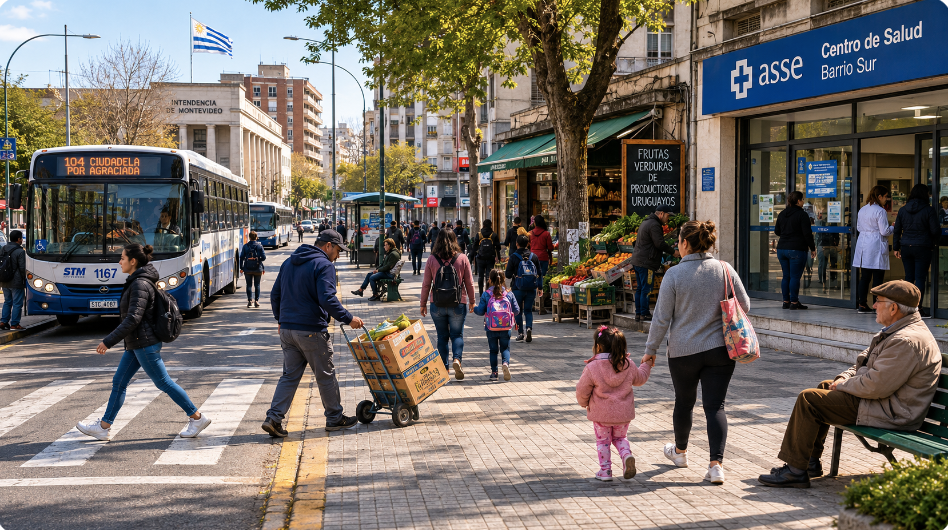
How crisis relief became durable welfare.
Relief became durable welfare through sequence.
Between 2005 and 2014, Uruguay rebuilt its welfare state after the 2002 crisis. Poverty, debt stress, and institutional fragmentation defined the starting point. Within a decade, the Frente Amplio governments of Tabare Vazquez and Jose Mujica expanded health coverage, reduced inequality, revived wage bargaining, and sharply increased social spending. They did so without breaking fiscal credibility.
The central mechanism was not redistribution alone. Uruguay moved from emergency relief to durable institutions while preserving confidence among creditors, investors, unions, and firms. The clearest example was the shift from Plan de Atención Nacional a la Emergencia Social (PANES), launched in 2005, to the protection system built through Plan de Equidad, Asignaciones Familiares – Plan de Equidad (AFAM-PE), and the Tarjeta Uruguay Social.
That sequence matters across Latin America and the Caribbean. Many governments try to expand welfare during commodity booms or post-crisis recoveries. This blog shows how Uruguay turned emergency relief into durable welfare by sequencing finance, administration, and coalition management. Redistribution lasted because those three elements moved together. That is the argument of this case.
Measured gains reshaped welfare and work.
Poverty fell as formalization deepened.
The gains were substantial. Poverty fell steeply after 2005, and inequality also declined over the next decade. Public social spending rose sharply between 2005 and 2013. Uruguay combined stronger distributional outcomes with institutional consolidation. That combination gave the reform cycle unusual durability.
The labor market also improved sharply. Unemployment fell from crisis-era highs to historic lows by 2014. Informal employment declined from 40.7 percent in 2004 to about 23.5 percent in 2014. Revived wage councils, broader social security coverage, and the inclusion of rural and domestic workers helped drive that change. Real wages also rose strongly after the 2002 collapse.
Institutions expanded while credibility strengthened.
The welfare system expanded through institutional redesign. PANES reached more than 100,000 households between 2005 and 2007. The government then moved many beneficiaries into Plan de Equidad, especially AFAM-PE and the Tarjeta Uruguay Social. Healthcare reform under the Sistema Nacional Integrado de Salud (SNIS) and the Fondo Nacional de Salud (FONASA) sharply expanded formal health coverage. FONASA enrollment rose from about 1.2 million users in 2008 to about 2.6 million by 2014.
The state also rebuilt fiscal credibility after the debt crisis. Public debt ratios fell sharply over the decade. The government de-dollarized sovereign debt exposure and rebuilt international reserves. Uruguay later regained investment-grade status while keeping its welfare commitments. That combination set this period apart from earlier redistribution cycles funded through unsustainable borrowing.
Sequencing made redistribution politically durable.
Emergency relief became a permanent social policy.
The strongest explanation lies in sequencing under macroeconomic constraints. The Frente Amplio governments did not treat emergency relief as a permanent answer. They used PANES to stabilize vulnerable households after the crisis. At the same time, they built the administrative and political base for longer-term reform.
That sequence was deliberate. MIDES was created in March 2005 within the administration’s first hundred days. PANES targeted the bottom 20 percent of households through cash transfers, food support, and public works. It also had a sunset mechanism. When PANES ended in 2007, beneficiaries moved into Plan de Equidad, AFAM-PE, and the Tarjeta Uruguay Social.
Fiscal repair widened the room for redistribution.
The reform package also depended on fiscal redesign. The 2007 tax reform introduced the Impuesto a la Renta de las Personas Fisicas (IRPF), a dual personal income tax, and modernized the Dirección General de Impuestos (DGI). Before reform, indirect taxes dominated revenue collection. After reform, the tax mix became more progressive. Reputable studies suggest the reform reduced inequality modestly and lowered poverty at the margin.
Macroeconomic management created room for those commitments. Under Danilo Astori’s economic team, Uruguay signed a 2005 International Monetary Fund (IMF) Stand-By Arrangement and maintained primary surpluses, controlled inflation, restructured debt, and accumulated reserves. The Central Bank also strengthened asset and liability management and reduced financial dollarization. Those steps cut rollover and currency risks before recurrent welfare obligations expanded.
External conditions also mattered. Commodity exports, especially soy, beef, and dairy, generated liquidity during the boom years. Foreign direct investment (FDI) also expanded through the Investment Promotion Law and major forestry investments, especially UPM. The evidence supports the claim that welfare expansion depended partly on those favorable conditions. It does not support the stronger claim that redistribution financed itself internally.
The state coordinated risk, labor, and care.
Public agencies rebuilt targeting and delivery.
The Uruguayan state acted as provider, market shaper, regulator, and risk manager. It did not just spend more. It reorganized relations among labor, finance, healthcare, and social protection. That wider coordination made the welfare sequence work.
Direct provision expanded through the Ministry of Social Development (MIDES), the State Health Services Administration (ASSE), and the transfer system. MIDES coordinated PANES, administered the Tarjeta Uruguay Social, and later automated AFAM-PE transfers through integrated databases with the Social Security Bank. Because MIDES inherited weak capacity, the state partnered with Universidad de la República to build the Critical Deficiency Index targeting system. That was capacity repair, not simple continuity.
Tripartite bargaining widened formal labor protection.
The state also shaped markets directly. The reactivation of the Consejos de Salarios in 2005 forced employers, unions, and the state into tripartite bargaining. Wage councils set sectoral wage floors, favored lower-income wage adjustments, and extended bargaining into domestic and rural labor. Domestic workers entered formal bargaining structures for the first time in 2008. These mechanisms helped reduce informality and expand social security coverage.
Business chambers resisted these reforms. Employers warned that mandatory bargaining and wage floors would hurt small firms and create rigidities. Yet the councils also showed negotiated flexibility during downturns. Firms and unions used unemployment insurance rotations and temporary suspension of non-salary benefits to preserve jobs. The labor market did not show the collapse critics predicted.
Healthcare reform showed a hybrid model of state intervention. The government did not nationalize private providers. Instead, FONASA pooled worker contributions while citizens chose between ASSE and private Instituciones de Asistencia Medica Colectiva (IAMCs). The Ministry of Public Health moved toward system regulation, while the Junta Nacional de Salud (JUNASA) handled contracts and operational oversight. This design expanded coverage quickly without large capital outlays.
Universal coverage did not remove stratification. Critics argued that ASSE still served poorer and more isolated populations, while IAMCs attracted healthier formal workers who could afford co-payments. The evidence supports universal formal coverage. It does not support a stronger claim of equal access quality or equal treatment conditions.
The state also accepted hybrid arrangements and bounded exits. Public-private partnerships financed infrastructure while public authorities ensured coordination. The National Development Corporation and private-sector support programs aligned investment flows without building a centralized industrial policy apparatus. The dossier supports state coordination and capital crowding-in. It does not support claims of comprehensive sectoral conditionality or East Asian-style industrial discipline.
LAC reforms require sequence, finance, and coalitions.
Durability depended on visible fiscal limits.
The first lesson is about constraints. Uruguay succeeded because the government made fiscal and political limits visible early rather than concealing them. PANES was temporary by design. Tax reform came before full welfare expansion. Debt restructuring and reserve management also advanced before the distributive system matured.
Redistribution lasted because the government reduced financing risks before recurrent commitments became hard to reverse. Uruguay also did not begin with universal systems. It began with targeted emergency stabilization after crisis conditions broke household security. The PANES-to-Plan de Equidad sequence created administrative learning, political legitimacy, and beneficiary registries before larger systems expanded.
Coalitions held because trade-offs stayed explicit.
The third lesson concerns coalition management and trade-offs. The Frente Amplio kept a broad governing coalition by combining redistribution with macroeconomic orthodoxy, moderate capital taxation, and space for investment. Employers accepted some labor regulations because inflation stayed under control and capital flight risks were contained. Poor households gained transfers and services, while investors kept confidence in macroeconomic management.
The final lesson is cautionary. Uruguay’s distributive cycle slowed after 2014 as external conditions weakened. The dossier also warns that the model’s long-term sustainability remains contested. Growth, export rents, and foreign direct investment (FDI) supplied part of the fiscal space behind redistribution. Latin American and Caribbean governments should not mechanically copy Uruguay. The narrower lesson is to sequence reform only when coalitions, fiscal discipline, and administrative capacity can stay aligned long enough to institutionalize it.


Leave a Reply