Service-led growth drove rapid income convergence
Panama’s expansion between 2003 and 2014 ranks among the fastest and longest growth episodes in Latin America. Real GDP grew at close to eight percent a year over much of the decade. Per capita income doubled within the period. By the early 2010s, Panama had reached high-income status. The trajectory shows the scale of income convergence available to a small, open service economy.
The episode matters today because it shows how geography, openness, and investment can combine to produce exceptional growth. Panama used the Canal, its logistics position, and decades of commercial law to attract capital. Successive governments built on this base through infrastructure megaprojects, trade agreements, and special regimes for foreign firms. These choices reshaped the growth path faster than in any other economy in the region.
The same episode exposed the limits of growth without broad diffusion. Poverty fell, but by less than the pace of expansion would have predicted. Inequality fell too, yet stayed high, and territorial and social gaps remained stark. That mix of rapid growth and uneven inclusion makes Panama’s experience directly relevant for LAC policymakers pursuing durable, inclusive transformation.
This blog looks at what changed, what drove the changes, and where the state shaped, or failed to shape, the outcome.
Capital and services restructured the economy.
The most visible change was a sharp surge in capital accumulation. Gross fixed capital formation rose steeply after the mid-2000s. By 2014–2015, it exceeded 47 percent of GDP, far above regional norms. Capital became the largest single contributor to growth, accounting for most annual GDP expansion during the boom. Investment, more than productivity gains, drove the new economic structure.
Foreign direct investment reached levels unmatched in Latin America. Annual inflows approached ten percent of GDP by 2014. The stock of FDI per capita roughly tripled over the period. Investment went mostly into services: logistics, transport, finance, wholesale trade, construction, and real estate. Manufacturing stayed marginal in the growth model.
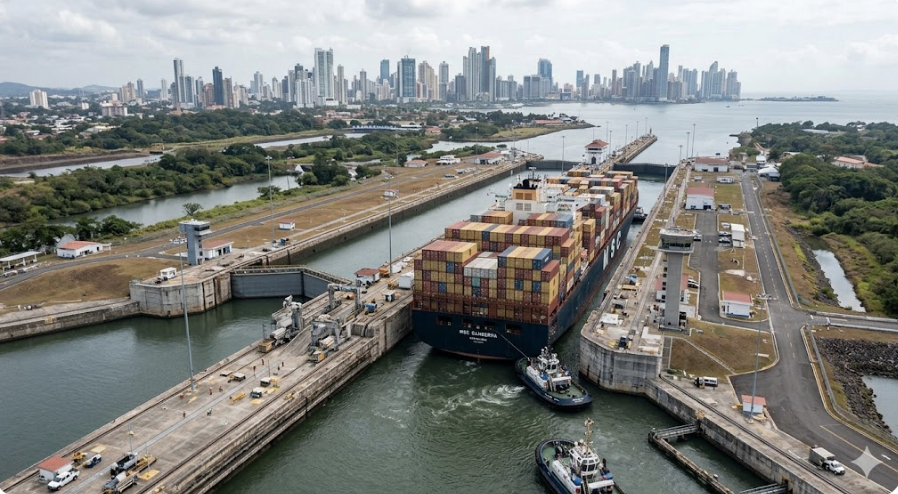
The service economy consolidated around the Canal. Logistics, ports, finance, communications, and trade formed a tightly linked cluster tied to global transit. Canal-related activity generated a large share of total output. Tourism exports also expanded quickly. Goods exports stayed small, deepening Panama’s specialization in services rather than production.
Large-scale construction reshaped the physical economy. The Canal expansion, metro lines, airports, highways, and urban redevelopment more than doubled construction’s share of GDP after 2007. Public and private projects transformed Panama City and the main transport corridors. The scale of non-residential building placed Panama among the most investment-intensive economies in the world.
Macroeconomic institutions adapted to support the capital surge. Fiscal rules capped deficits, public debt fell from mid-2000s levels, and investor confidence strengthened. Panama reached and held investment-grade status. The government issued long-maturity bonds at favorable rates. Stable macro conditions reinforced the investment cycle rather than constraining it.
Labor markets tightened quickly as growth accelerated. Unemployment fell to historic lows, and employment rates rose. Job creation exceeded half a million positions over the broader period. Employment shifted from agriculture to commerce, transport, finance, and construction. The structure of work changed alongside the structure of production.
Policy experiments met strong external pressures.
Change came through deliberate policy experimentation layered on top of strong market forces. Successive governments created differentiated special economic zones for specific functions: re-export trade, logistics, headquarters services, and innovation activities. Each zone offered its own tax, labor, and immigration regime. These place-based experiments produced wide variation in firm performance.
The Canal expansion was the largest and most consequential experiment. A national referendum authorized the project. The Canal Authority financed it on its own balance sheet, outside the central budget. An international consortium executed the works, linking Panama directly to global engineering and logistics capabilities. The expansion permanently increased shipping capacity and locked Panama further into global transit services.
External conditions strongly favored Panama’s service-oriented model. Global trade growth in the 2000s lifted demand for shipping, logistics, and financial intermediation. Panama captured that demand by taxing and facilitating flows rather than producing commodities itself. Capital and labor moved out of low-productivity activities and into globally connected services.
Those same external conditions also exposed vulnerabilities. Trading-partner crises and tariff measures after 2012 sharply reduced activity in the Colón Free Zone. Re-exports fell by nearly one-third within three years. Firm exits accelerated, and employment declined. The episode revealed Panama’s dependence on a narrow set of markets and partners.
Transport and connectivity infrastructure scaled successfully. Canal throughput grew, ports upgraded quickly, and air connectivity more than doubled within a few years. Panama’s airports and ports ranked among the best in comparable economies. These investments locked in scale advantages for logistics and transit services.
Knowledge diffusion stayed partial, even where enclave productivity was high. Firms inside the special zones reached much higher productivity and paid higher wages than firms outside. Immigrant workers generated positive wage and productivity spillovers within the zones. Labor and immigration rules limited the spread of those gains to the wider economy.
The state shaped markets but struggled to spread the gains
The Panamanian state actively defined the growth vision. Successive administrations positioned the country as a global logistics and services hub. National plans emphasized infrastructure, tourism, and links to global markets. Policy continuity across governments reduced uncertainty for investors.
The state shaped markets mainly through rules, not public ownership. Investment stability laws, headquarters regimes, and special economic zone legislation built a tiered incentive system. Trade agreements reinforced openness and market access. The state targeted specific activities by adjusting regulatory and fiscal conditions rather than producing directly.
Public investment was the central operational lever. Government infrastructure spending exceeded nine percent of GDP in peak years. These investments improved port infrastructure and global rankings for ports and transport. By building physical connectivity, the state directly opened opportunities for private firms.
Coordination with private finance succeeded unevenly. FDI responded strongly to incentives and macro stability. Public–private partnerships for infrastructure, by contrast, stayed limited because concession frameworks were weak. The state mobilized capital more effectively for individual firms than for shared infrastructure services.
Social investment lagged the economic expansion. Low tax revenue constrained both redistribution and service quality. Taxes and transfers reduced inequality only marginally. Years of schooling rose, but measured learning outcomes and the alignment of skills with labor demand stayed weak.
Institutional learning happened, but stayed incomplete. Authorities adjusted fiscal rules and built savings mechanisms to manage volatility. Weaknesses in monitoring, implementation, and transparency nonetheless persisted. These gaps limited the state’s ability to correct uneven outcomes as growth accelerated.
Rapid growth proved feasible; inclusion did not follow automatically
The clearest lesson is that disciplined openness and investment can deliver rapid income convergence. Panama sustained high growth without macroeconomic instability. Capital accumulation and service specialization drove the results. Few LAC economies have matched this scale of transformation.
For LAC policymakers, the harder task is building a service economy with broader domestic integration. The aim is for gains to reach beyond the enclaves and the capital region. Productivity improvements would then spread to local firms and workers. Human capital constraints would ease rather than tighten as growth accelerates.
The evidence points to a few practical priorities. Better education quality and stronger skills alignment would lift productivity beyond what capital deepening alone can deliver. Stronger institutional capacity and transparency would support sustained investment. Deeper links between the Canal cluster and domestic firms would broaden the spillovers from growth.


Leave a Reply