A windfall captured but never disciplined.
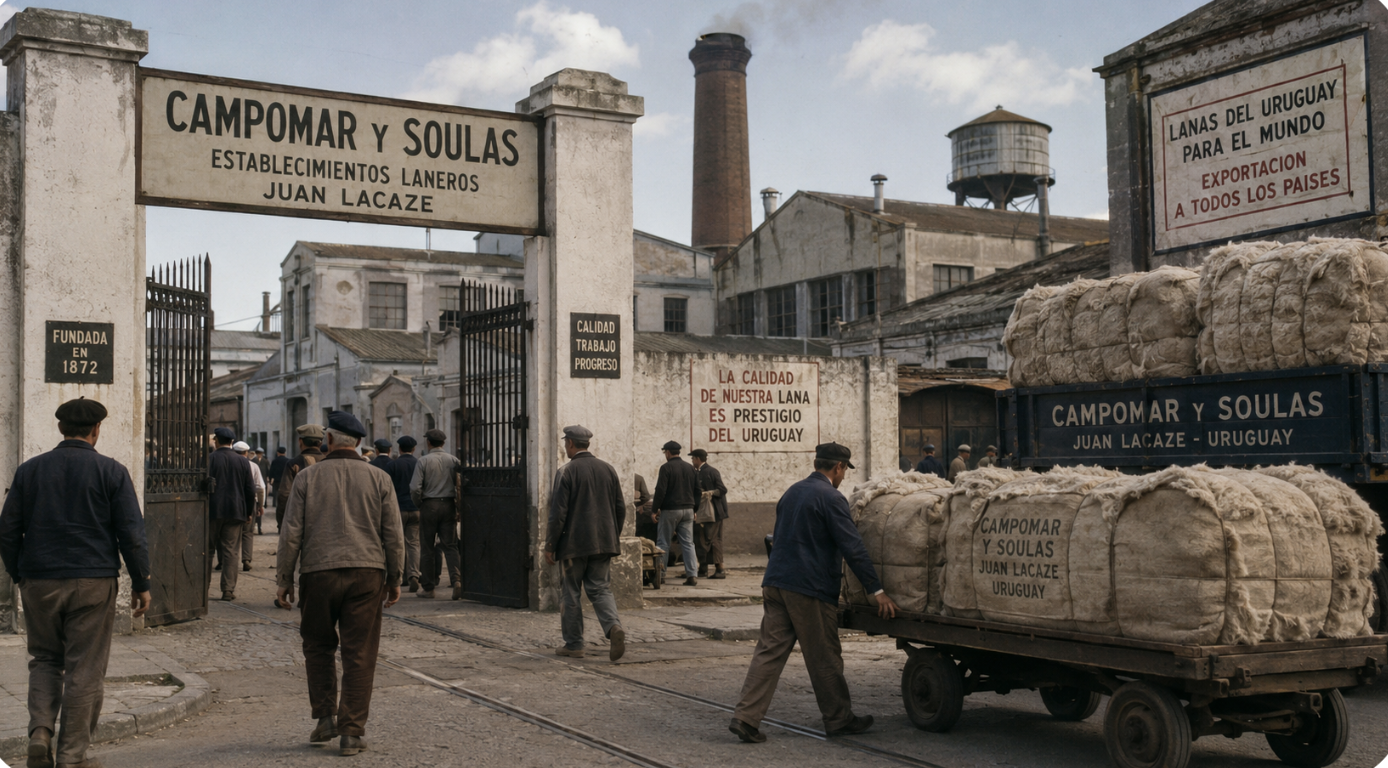
In the late 1940s, thousands of workers passed through the gates of Campomar y Soulas in Juan Lacaze each morning. They processed Uruguay’s wool into industrial exports. The firm embodied a larger shift. Uruguay redirected wartime and Korean War commodity rents away from pastoral exporters and toward protected industry, urban wages, and a dense welfare system.
That shift reshaped Uruguay’s institutions more deeply than Uruguay’s productive base did. The state could capture the boom and even pick a winner, but it could not discipline firms, coordinate upgrading, or withdraw support. The same exchange-rate machinery that funded factories and social protections locked the country into a fragile bargain. Volatile commodity rents and an ecologically constrained ranching economy carried the weight. This essay examines what changed across the 1940s, what drove those changes, and the role of the Uruguayan state.
Wartime rents rebuilt Uruguay’s productive structure.
Campomar y Soulas made the industrial turn work. By 1936, the company employed roughly 2,000 workers and held 34 to 38 percent of the textile labor force. State-set exchange rates later let the firm export finished wool products at preferential rates. Raw wool exporters absorbed the implicit tax through the same foreign-exchange system.
The shift was measurable across production, employment, and institutions. Manufacturing climbed from roughly 12.5 percent of GDP in 1930 to 17.7 percent in 1940, 18.9 percent in 1945, and close to 20 percent by 1950. Industrial employment expanded even faster. Industrial workers rose from 46,204 in 1930 to 140,454 by 1948, a 144.3 percent increase across the wider 1938-1957 period.
Timing mattered. Wartime demand generated the foreign-exchange reserves, but wartime disruption still constrained manufacturing because imported machinery and inputs remained scarce. The decisive acceleration arrived after the war, when the release of those accumulated reserves financed capital imports. By 1950, the Banco de la República Oriental del Uruguay (BROU) held foreign-exchange and gold reserves of roughly USD 312 million.
The commodity shock behind this expansion was extraordinary. Wool prices rose from 8.21 pesos per 10 kilograms in 1939 to 23.64 pesos by 1950. The terms-of-trade index climbed to 135 in 1950 and peaked at 180 in 1951. Raw wool alone supplied roughly 60 percent of the total export value in 1950.
A new urban settlement took shape.
Institutional change moved in parallel. Law 10.449 created the Consejos de Salarios in November 1943 and set regulated wage bargaining across twenty private-sector activity groups. The same law established employer-financed family allowances. Pension coverage expanded under Law 10.197 in 1942, Law 10.318 in 1943, and Law 11.034 in 1948, which restructured the pension system.
Real wages rose by roughly 38 percent between 1945 and 1950. Wages rose strongly, but the broader distributional shift was less dramatic than the wage figure alone suggests. State employment passed 20 percent of the labor force by the early 1950s. Uruguay did not simply grow industrially. It built a new urban settlement around protected manufacturing, organized labor, and state jobs.
Fragility emerged inside the boom itself. Export prices surged while export volumes stalled. Agricultural productivity deteriorated over the longer period. The terms-of-trade index collapsed back toward 100 after 1951. Campomar itself later ran at only 45 percent capacity. The firm that symbolized the ascent foreshadowed the system’s vulnerability.
Exchange controls redirected the commodity windfall.
The changes began with an external windfall, but commodity prices alone did not decide who captured the gains. Uruguay’s inherited fiscal-monetary apparatus redirected the boom through a set of state-controlled chokepoints.
The central mechanism was the multiple-exchange-rate regime formalized under Law 10.000 in 1941. Agricultural exporters surrendered foreign exchange to the BROU at an artificially low official rate. Industrial firms then bought that foreign exchange at preferential rates to import machinery, fuel, and inputs.
The textile sector clearly demonstrated how this worked. Raw wool exporters surrendered dollars at approximately 1.519 pesos per USD. Exporters of finished wool products, such as Campomar, received a preferential rate of 2.35 pesos per USD. That deliberate differential encouraged value-added processing rather than raw-wool exports. Finished wool products later reached 23.3 percent of total exports by 1959.
Physical allocation mattered as much as pricing. The Contralor de Exportaciones e Importaciones (CEI) administered individual quotas and prior permissions that restricted imports and rationed scarce foreign exchange. The CEI combined state and private-sector seats, embedding industrial interests inside the allocation system.
The state also monetized the spread between buying and selling rates through the Fondo de Diferencias Cambiarias. By 1950, the exchange-rate tax generated 31.46 million pesos, more than 30 percent of the Fund’s total income. These resources financed public spending, subsidized urban consumption, and bankrolled the industrialization strategy.
Intervention without conditionality hollowed out the gains.
BROU sat at the institutional core of this system. It controlled foreign exchange and accumulated reserves during the commodity boom. BROU helped finance the system, but it behaved more like a foreign-exchange manager and cautious commercial lender than a true development bank. This approach was limited. Uruguay lacked a developmental-planning apparatus capable of disciplining firms, coordinating investment, or imposing performance conditions.
That distinction in the BROU’s functions matters. The system was interventionist without becoming developmental in the East Asian sense. Uruguay picked sectors and subsidized industrial expansion but imposed no meaningful conditionality or exit discipline. Protection became politically negotiated rather than performance-based.
Campomar illustrates both sides of this pattern. The firm expanded rapidly under preferential exchange rates and protected domestic markets. Yet the system imposed few mechanisms to force productivity upgrading or competitive discipline once protection arrived. The transfer system also leaked heavily. Established importers treated quotas as tradeable assets, while firms such as Fermonda exploited exchange controls through fraud and arbitrage.
The ranching economy compounded the problem. Uruguay’s livestock sector already faced ecological limits rooted in extensive natural-pasture systems. Agricultural total factor productivity fell by 0.4 percent a year between 1930 and 1960. Wheat expansion displaced meat and linseed acreage because Uruguay lacked a major agricultural frontier. Discriminatory policies further weakened incentives, but ecological stagnation preceded the transfer system itself.
The state organized rents into coalitions.
The state did more than regulate markets in this period. It actively reorganized the distribution of rents, employment, and political loyalty.
The Wage Councils became the centerpiece of the new labor order. Each council included three state delegates, two employer representatives, and two worker representatives. The state reserved the authority to reject wage agreements considered irrationally low. Law 10.644 later strengthened enforcement through judicial recovery procedures for unpaid wages.
These institutions expanded organized labor through incorporation rather than confrontation. Workers increasingly pursued gains through state-sanctioned bargaining rather than strikes. The state tied labor stability to the protected industrial economy.
Family allowances and pension expansion reinforced the same coalition. Employer-financed contributions funded benefits for dependent children, while new pension legislation expanded coverage across urban and rural sectors. Tripartite administrative structures embedded workers, employers, and the state inside the welfare system itself.
Patronage and capacity defined the settlement.
Neo-Batllismo under Luis Batlle Berres transformed these policies into a broader political settlement after 1947. The coalition united organized labor, urban middle sectors, industrialists, and public employees through controlled distribution of economic rents.
Public employment sat at the center of that arrangement. State jobs expanded rapidly and operated partly through party patronage networks run by both Colorado and Blanco organizations. Durability came not only from wages and welfare but also from opposition co-optation through state job quotas. The state bought political durability through institutional inclusion rather than coercion.
The state also possessed unusual infrastructural capacity for the region. BROU controlled finance and foreign exchange. Public enterprises such as UTE and ANCAP shaped the energy, utilities, and fuel distribution sectors. Uruguay inherited strong interventionist institutions from earlier Batllista reforms.
Yet the same state displayed major coordination weaknesses. Uruguay lacked specialized planning agencies capable of long-term industrial strategy. Lobbying groups such as the Union Industrial Uruguaya constantly renegotiated exchange rates, quotas, and protections. Industrial policy existed but operated without coherent discipline or coordinated upgrading.
That distinction shaped the system’s long-term weakness. The state effectively captured and redistributed wartime rents. It did not build a self-sustaining industrial structure capable of surviving the collapse of commodity prices.
Lessons for commodity-dependent economies in LAC.
Uruguay’s experience carries lessons about sequencing, institutional durability, and the political economy of commodity-financed change.
First, rent capture alone does not create developmental change. Uruguay redirected commodity rents into manufacturing, wages, and welfare institutions. But protection without conditionality rewarded political bargaining more reliably than productivity upgrading. States can subsidize industry quickly. Building disciplined industrial capabilities takes far longer.
Second, institutional durability can outlast the economic conditions that financed it. Uruguay built powerful constituencies around public employment, wage bargaining, and welfare entitlements during the boom. Those constituencies became political veto players that resisted retrenchment once external conditions worsened.
Third, commodity booms can temporarily hide ecological and productive constraints, not permanently. Uruguay’s livestock economy financed industrialization even as it approached the limits of extensive pasture production. The transfer system redistributed rents from a productive base that was already losing dynamism.
Fourth, state capacity is multidimensional but not uniform. Uruguay had deep fiscal and monetary reach through BROU and exchange controls. It lacked matching planning and coordination capacity. Large public institutions alone do not guarantee developmental effectiveness.
The trade-off facing LAC policymakers today.
Finally, the case sharpens a central trade-off facing Latin American and Caribbean policymakers today. Commodity rents can finance rapid social inclusion and institutional expansion during favorable external cycles. But redistribution without productive upgrading breeds vulnerability once export conditions reverse. Uruguay built durable welfare and labor institutions faster than it diversified the economy beneath them.
Campomar shows the core lesson in one firm: the state could select a winner, but it could neither make it competitive nor let it fail.


Leave a Reply