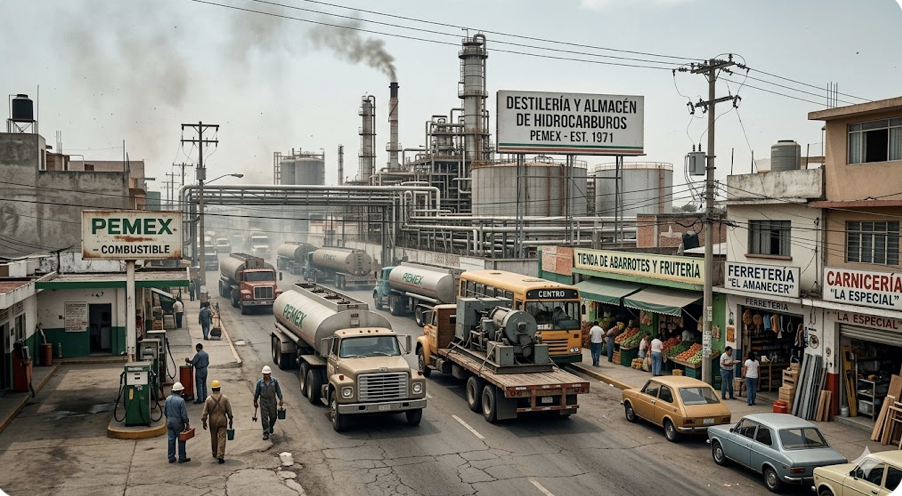
By 1981, Mexico was buying far more from abroad than four years earlier, even as oil money poured in. Mexico’s 1977–1981 oil boom, driven by PEMEX’s fast expansion and a shift to exports, reshaped the economy. Crude exports rose from 0.20 million barrels per day (1976) to 1.15 million (1981). Production climbed from 650,000 barrels per day (1974) to over 2.3 million (1981). At the same time, imports of key goods surged. More oil, more spending, more borrowing, and more imports defined the boom years.
New reserves and higher oil prices eased Mexico’s financial constraints and made fast expansion seem safe. Oil looked like a quick path from the 1976 crisis to prosperity. Public investment rose. Employment expanded in high-wage manufacturing and the public sector. The state also widened its role across the economy. A better outcome would have used the windfall to build lasting capacity, without tying growth to fragile external credit or to a single export. However, heavy external borrowing, a rigid exchange rate, and large subsidies made the boom more exposed as conditions changed.
Mexico’s experience points to a clear priority: treat commodity windfalls as temporary and avoid lasting increases in public spending and debt. When oil revenue and external credit rise together, they can finance investment and consumption very quickly. However, they can also lock the economy into dependence and deepen the crash when prices fall or funding dries up. The sections below show what changed for people and firms, how the boom worked, and what the state did through action and delay. Readers can then judge which decisions delivered strength and which created fragility.
Exports, Investment, and Imports Rose Together.
How the Expansion Changed the Economy.
Mexico’s oil base expanded at extraordinary speed after 1976, starting with a sharp jump in proven reserves. Proven hydrocarbon reserves rose from 6.4 billion barrels (1975) to 16 billion (1977). By 1980, they were valued at levels described as 1,370% of GNP. Strategy also shifted from using oil mainly at home to pushing exports. Crude oil accounted for more than 99% of oil exports. By 1981, oil accounted for 75% of export revenues. This new export profile changed how Mexico earned foreign exchange and financed growth.
The boom also came with an investment drive that reshaped production beyond oil. Gross fixed capital formation rose from 18.9% of GDP (1977) to 24.9% (1981). Public investment increased from 7.2% to 10.8% of GDP. Private investment rose from 11.7% to 14.1%. Nonresidential fixed investment more than doubled between 1976 and 1981. Large increases appeared in petrochemicals, steel, and transportation. Employment also grew quickly. High-wage manufacturing rose 27.2%, and public-sector employment rose 41.4% during 1978–1981. Even with a few direct oil jobs, the boom spread through construction, heavy industry, and public projects.
Why the Gains Came with Strain.
But the boom also created strains that people and firms felt through prices, imports, and financial pressure. A 30% real appreciation accompanied a fixed but adjustable exchange rate. That made imports cheaper and local tradable sectors less competitive. Imported intermediate inputs rose 128% (1977–1981). Consumer goods imports reached 4.4 times their 1977 level by 1981. Inflation averaged 20%. The public deficit reached 14.7% of GDP (1981) as fiscal expansion accelerated.
Between 1977 and 1981, Mexico saw a rare mix: oil exports and investment surged, but so did import dependence and macroeconomic risk.
Oil Finds and Easy Credit Changed Incentives.
What Powered the Boom?
The boom’s first engine was the link between oil discoveries and changes in global oil markets. A sharp reserve re-estimation after 1976 raised expectations and encouraged the fast expansion of extraction and export infrastructure. Oil price shocks in the 1970s also raised the payoff to exporting. They strengthened the political and economic case for an oil-led strategy. As oil’s share of exports rose, public finances leaned more heavily on hydrocarbons. Oil reached more than 50% of fiscal revenues by the early 1980s and about 65% of export earnings in that period. This concentration made income and budgets more sensitive to energy markets.
The second engine was the tight link between oil revenue and external borrowing. External debt rose sharply, from $29 billion (1978) to $80 billion (1982). It was also described as quadrupling between 1975 and 1982. Net foreign borrowing financed about two–thirds of windfall-driven investment. Officials treated expanding reserves as one reason credit remained available. Domestic financial channels reinforced the surge by channeling international capital to local users. Heavy foreign borrowing helped sustain investment and consumption, even as current-account pressure widened.
How Policy Locked in Risk.
Policy choices helped the boom spread quickly and lock in its weakest features. The state moved quickly from the 1976 stabilization setting to an expansionary approach, often described as administering abundance. Public spending became a main growth driver. Banco de México financed deficits by expanding the monetary base. The exchange rate stance and subsidies pushed the economy toward import- and energy-intensive production. Mexico considered joining GATT in 1979 but reversed that decision in 1980 under pressure from import-competing interests. That reversal showed how political coalitions could block structural change during the boom.
The boom fed on itself because oil income, external credit, and domestic policy all pushed in the same direction: fast expansion first, greater exposure later.
The State Drove the Boom, Then Delayed Action.
How Government Shaped the Boom.
Government strategy and ideology shaped the boom from the start. PEMEX held a monopoly across the oil value chain, and the federal government used it as the main vehicle for an export-led oil strategy. The state also expanded its direct role in the economy. The number of state-owned enterprises rose from 504 (1975) to 1,155 (1982). Public spending also surged over the longer period, rising from about 10% to 22% of GDP (1970–1982). These choices reflected a view that oil wealth could solve structural constraints without traditional adjustment.
The state also shaped markets through prices, the exchange rate, and financial rules. Internal energy prices rose at one–third the rate of the GDP deflator. That created a large domestic subsidy that changed costs across the economy. A rigid exchange-rate stance came with the import surge and reinforced the shift toward imported inputs and consumer goods. Financial policy used high reserve ratios, around 34%, to steer commercial bank resources toward government financing. Reforms such as the 1976 Multiple Bank reform also aimed to reshape financial intermediation. Together, subsidized prices, import-friendly conditions, and state-directed finance drove the boom’s pace and shape.
Why the Adjustment Came Too Late.
When conditions turned in 1981, state choices and limits reduced the room to adjust. Some accounts describe fiscal policy in 1981 as neither more restrained nor more reckless, but rather as exacerbating external conditions. The state also used targeted support and guarantees, including a $500 million bailout of the Alfa group in 1981. That reinforced expectations that large borrowers would be backed up. Internal conflicts also emerged within the state. One example was the split between the Secretariat of Programming and Budget and the Treasury over production limits.
The state did not just join the boom. It amplified it through PEMEX, subsidies, directed finance, and delayed adjustment as risks grew.
A Boom Can Build Capacity or Crisis.
The central lesson is practical: treat an oil windfall as temporary income and keep budgets and borrowing aligned with that assumption. Mexico’s experience from 1977–1981 shows how quickly success can turn into exposure when spending, credit, and the exchange rate all tilt toward expansion. A more durable outcome comes from separating long-term public commitments from volatile export revenue. It also comes from limiting reliance on external debt tied to commodity cycles. The three anchors explain why the boom produced fast gains and rising fragility at the same time.
Mexico went through a visible transformation. Oil exports, investment, and employment rose. At the same time, imports, inflation, and fiscal imbalance also increased. Oil discoveries and price shifts drove the change, along with abundant external credit. Policy settings then reinforced the cycle. The state led the strategy through PEMEX, subsidies, and financial tools, then struggled to tighten as pressure rose. Together, these forces created an economy that could grow rapidly in good times but remained highly exposed to shifts in oil prices and global financial markets.
By 1981, Mexico imported far more goods even as oil exports surged. That was a sign of both purchasing power and dependence. If windfalls finance investment without locking in deficits, overvaluation, and debt, the same boom can expand capacity without widening risk. The evidence from this period points to clear priorities that follow from the boom’s mechanics. Avoid treating windfalls as permanent. Limit debt-fueled expansion. Prevent policy incentives that reward import dependence. When those safeguards fail during a commodity boom, costs rise quickly when prices fall, or credit tightens.


Leave a Reply