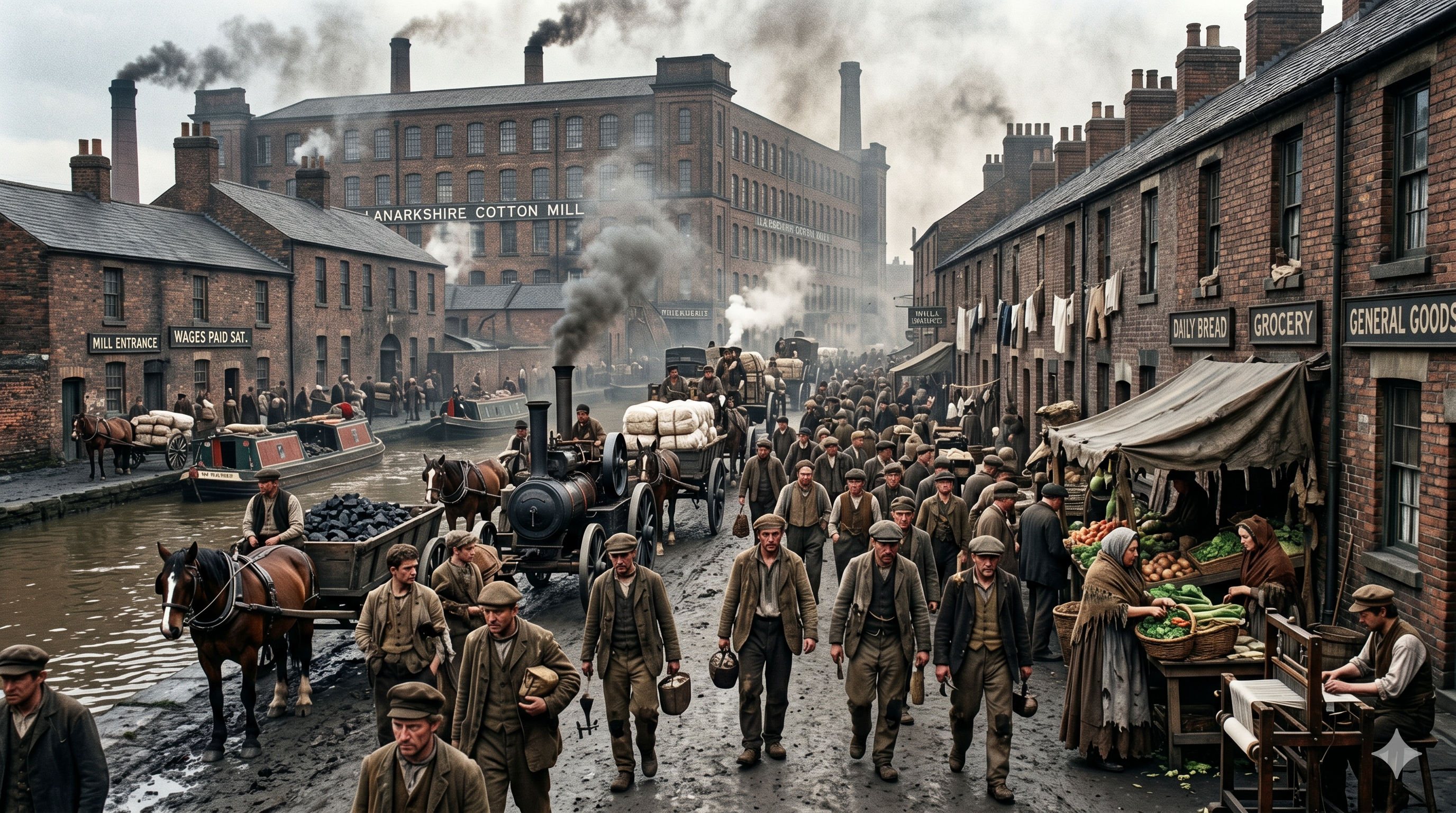
Britain’s first industrial surge did not translate into a steady rise in living standards. Factories and mechanized work expanded output, and coal and iron reshaped production. Yet many families stayed close to subsistence and faced harsh urban conditions. In the early 1800s, roughly 1 million people—over 10% of the population—received poor relief each year, even as national income grew. That gap between national progress and daily life set the stage for conflict, reform, and hard lessons about how growth spreads.
This transformation unfolded across Britain from 1780 to 1820, with the clearest gains in cotton, iron, and transport. Over these decades, the economy moved away from a land-limited “organic” system toward a mineral-based growth centered on coal and new industrial assets. At the same time, enclosure removed common lands and pushed many rural people into wage work and factory discipline. The pressure point was simple: the country could modernize quickly, but many people could not adapt or benefit at the same speed.
A practical lesson follows from that history: pair productivity pushes with rules and services that protect people during rapid change. In Britain’s case, the driver was not “technology alone.” It was a bundle of property-right changes, deeper finance, wider knowledge diffusion, and state actions tied to war, trade, and domestic order. This blog explains what changed, how the shifts spread through the economy, and what the state did—and did not do—while the system reconfigured. By the end, readers can judge which parts of the British experience still matter when countries try to transform fast without leaving most households behind.
What changed — The shifts people could see.
Britain’s energy and production base shifted sharply toward coal, iron, and mechanized industry. An economy constrained by land and “organic” energy moved toward a mineral system powered by coal extraction. Industrial fixed capital expanded as investment flowed into factories, canals, turnpike roads, and mechanized equipment. Capital stock in modernized sectors rose quickly, with cotton textiles showing especially large increases over time. This shift let firms concentrate production and scale output beyond what craft tools and farmland could support.
Trade and finance also changed shape in ways people could feel through jobs, prices, and local opportunity. Cotton goods rose from 2% of exports in 1770 to 44% by 1830, making textiles a dominant outward-facing industry. Financial assets deepened rapidly, with banking assets rising from 15.2% of national income in 1775 to 27.9% by 1800. A dense network of “country banks” grew from nearly zero to over 800 by 1810, expanding access to working capital. The economy’s center of gravity also shifted, with growth moving from London toward the West Midlands, Lancashire, and West Yorkshire.
The social order reorganized around wage work, displacement, and sharper class lines. Enclosure—formal acts that converted common land into consolidated private farms—pushed many people off commons and into wage labor under tighter discipline. A working class formed as a “proletarian labor force” dependent on market wages. Industrial capitalists who owned factories and equipment gained more scope and more incentive to innovate. Poverty remained widespread in the early 1800s, with about 1 million people—more than 10% of the population—receiving poor relief each year by 1802.
Britain’s visible “takeoff” mixed rapid change with hard lives and sharper divides.
How it happened — The forces behind the shift.
Change began with many experiments in tools, processes, and organization, not a single breakthrough. Skilled mechanics and instrument makers produced “micro‑inventions” that turned designs into working machinery. They then kept cutting costs through trial and error and steady tweaks. Sectors moved at different speeds. Productivity rose sharply in a few areas—especially cotton, iron, and transport—while other parts of the economy changed more slowly. Business forms also varied, including joint‑stock associations that helped share risk even without limited liability. Over time, approaches spread because they worked and could be copied or adapted.
Strong pressures pushed the system toward labor‑saving machinery and new energy use. Britain’s relatively high wages gave firms a reason to invent and adopt labor‑saving machines, even when those machines were costly. Resource constraints mattered too. Deeper coal mining required better ventilation and steam-powered pumps, so new technology followed the demands of extraction. War also reshaped choices. The Napoleonic Wars pushed the state to develop new fiscal tools, including an income tax introduced in 1798. These pressures reinforced each other across markets, resources, and politics.
Diffusion depended on practical channels that moved goods, people, and ideas. Canals and improved roads linked rural production to urban centers and sped the movement of inputs and outputs. Knowledge also traveled through correspondence and print, with intellectuals “free to correspond” across the Atlantic and institutions promoting an “Enlightened Economy.” Formal bodies also tried to standardize and scale practices. For example, the Board of Agriculture (1793) published 90 volumes of recommendations that supported enclosure and related changes.
Britain’s shift grew from experiments and pressure, then spread wider through networks.
The state’s role — Rules, money, and missed basics.
Property rights and land reshaped.
The state did not stand aside. It rewrote core rules and backed large shifts in land and power. Enclosure worked as a form of economic planning. Nearly 4,000 parliamentary acts reordered property rights and replaced open fields with consolidated private farms. The state also built and defended a fiscal‑military strategy that aligned landed and commercial interests to fund global dominance. In practice, it mobilized domestic resources through taxation and debt. It also used naval power to defend trade routes and expand market access. These choices supported capital accumulation, even as they intensified displacement and class tension.
Trade rules and market design.
The government also shaped markets through trade rules, selective protection, and the legal environment for enterprise. The Navigation Acts and a state-supported Atlantic trading system set the framework for trade and reinforced Britain’s commercial reach. Tariffs were used pragmatically. For example, the Calico Acts protected against Indian cottons until domestic producers could compete, and the Acts were repealed in 1774 under pressure from inventors such as Arkwright. Patent law existed, but it was expensive and time‑consuming. That made the incentive effect for small inventors unclear in this period. In short, “market rules” were designed, enforced, and repeatedly adjusted.
Finance, infrastructure, and neglected basics.
The state also mobilized financial resources and operated a complex system that combined central power with local delegation. A large national debt helped meet the costs of global and technological wars. The Bank of England operated as a public-facing private corporation that managed state credit and expanded military capacity. Parliament provided “vital authority” for turnpike roads and bridge construction, while local bodies managed poor laws, roads, and parts of health care. Yet the state neglected several basic needs early on—especially urban planning, public health protection, and national public education. It also relied heavily on punitive orders and delayed the regulation of labor conditions until later decades.
The same pattern showed up at the local level. Central finance and military demands drove the system, while local bodies carried much of the day-to-day burden. Parliament empowered roads and bridges through the turnpike authority, and local officials administered poor relief, roads, and parts of health care. However, early public investment in city planning, sanitation, and education lagged behind the pace of urban growth. The state enforced often through punishment, and protections for workers arrived later.
Britain’s state planned, shaped markets, and financed war, but left core protections and skills investments thin during rapid change.
What it means — Grow fast without leaving people behind
Countries that want fast productivity growth can take a simple lesson: speed up innovation, but do not leave social foundations to chance. Britain’s experience linked industrial scaling to property-right redesign, deeper finance, and knowledge diffusion. However, everyday welfare improved slowly and unevenly. A better outcome is a transformation where jobs and output expand without locking large groups into long-term hardship and repeated unrest. The three Anchors show why Britain achieved a powerful takeoff and why it paid such high social costs along the way.
The record shows a visible mix of gains and strain. Modern sectors expanded, finance and trade surged, and poverty and class division remained severe for many households. Growth turned on how experimentation met selection pressures from high wages, war finance, and resource constraints. It then spread through infrastructure and knowledge channels. The state played a dual role. It reorganized property rights and mobilized finance, but it delayed or underprovided key social and human-capital supports. Together, these patterns describe a system-wide transformation, not a narrow story about machines.
At street level, the test is not whether “industry grows.” It is whether families feel the benefits soon enough to sustain stability and trust. Britain’s early 1800s saw industrial advance paired with mass reliance on poor relief, and pressures that later fed reform and conflict. The priorities are practical: build institutions that spread useful knowledge, stay flexible on trade strategy, and put safeguards in place before hardship dominates public life. Otherwise, rapid change can “work” on paper while leaving large parts of society stuck in a long plateau of insecurity.


Leave a Reply