Every so often, societies experience periods of accelerated change. Innovative technologies emerge that do more than improve daily life — they reshape economies, reorganize communities, and alter how people relate to one another. In these moments, the decisions that individuals, businesses, and institutions make determine whether they adapt, stagnate, or fall behind.
Today, we are living through one of those periods.
Across the world, the systems that support modern life — energy, information, production, mobility, and finance — are shifting at a pace that would have been difficult to imagine a generation ago. Solar and wind power have become among the most affordable sources of new electricity. Battery costs have fallen dramatically, enabling the expansion of electric mobility. Artificial intelligence is spreading faster than any previous technology. Digital payments, online commerce, streaming services, and virtual learning have become part of everyday routines. Electric vehicles, once a niche product, now outsell gasoline cars in several major markets.
These changes are not gradual. They are exponential.
Some societies and companies are moving quickly, investing in innovative technologies and building the skills and infrastructure needed to support them. Others are moving more slowly. As in every significant period of transformation, the pace of adaptation shapes who benefits and who struggles.
We Have Seen Transformations Like This Before
Although today’s technologies feel new, the pattern of rapid change is not. Over the past 400years, human societies have experienced repeated waves of innovation — each reshaping how people use energy, materials, information, and capital.
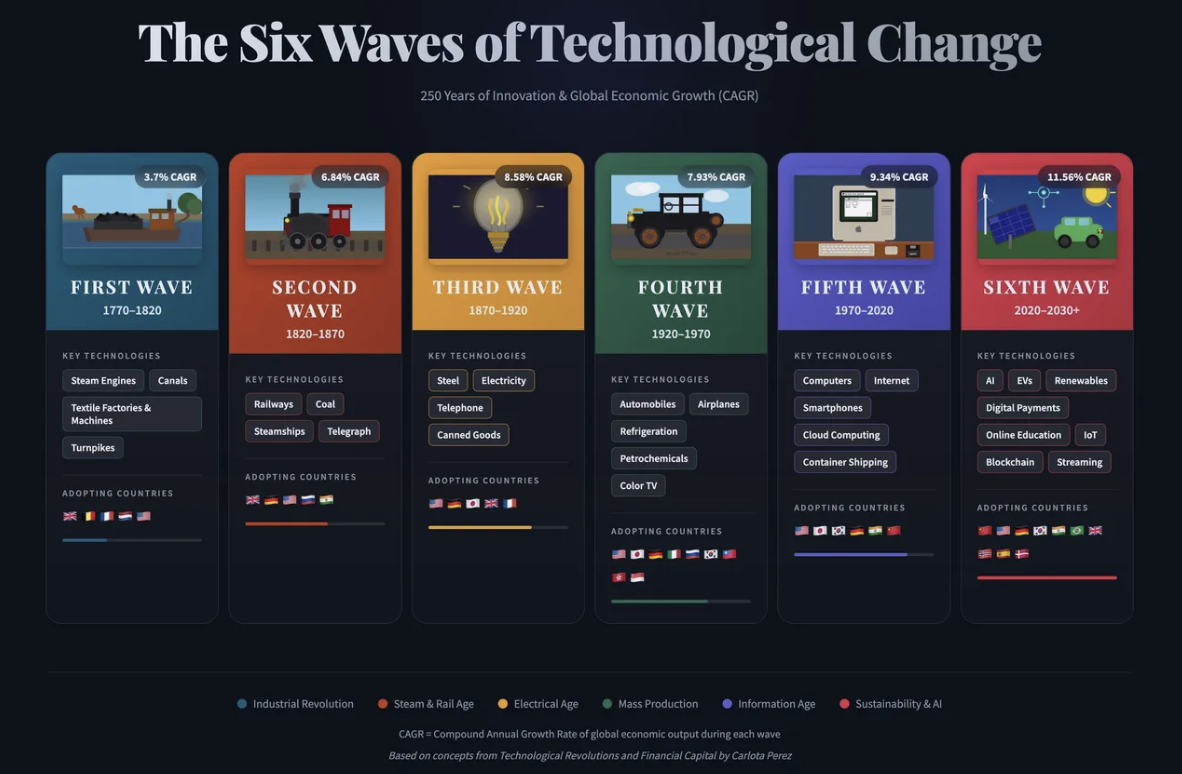
Early industrialization(1770–1820) introduced steam engines, canals, textile machinery, and the factory system. Britain’s textile output increased tenfold between 1770 and 1830. Coal powered the machines, and plantation agriculture provided raw materials and capital that supported industrial expansion.
The transportation revolution (1820–1870) connected regions at unprecedented speed. By 1870, industry had built 100s of thousands of kilometers of railway worldwide, and steam had begun to replace sailing ships. Telegraph lines linked markets and accelerated communication, drawing distant regions into shared economic systems.
Early electrification (1870–1920) transformed cities and industries through the widespread adoption of lightbulbs powered by expanding electrical networks. Steel production rose from 1 million tons in 1870 to more than 28 million tons by 1900. With the steel came canned products. Electric lighting, telephones, and mass manufacturing reshaped daily life.
The oil and automobile revolution (1920–1970) changed mobility and consumption. By 1970, more than 200 million cars were on the road, and oil had become a central resource in global trade and industry. Petrochemicals from oil and electronics from refrigerators to color televisions appeared in every house.
The digital revolution (1970–2020) rewired the world. Computers, the internet, smartphones, cloud computing, and global supply chains created a new economic architecture. Today, more than 5 billion people use the internet, and digital platforms have become essential infrastructure. At the same time, global trade grew, fed by the shift to container shipping.
It is tempting to imagine these revolutions as cleanly separated eras, but technological change rarely works that way. Old and new systems often coexist for decades. Infrastructure, institutions, and cultural norms evolve more slowly than the technologies themselves. Revolutions are not single events — they are long, uneven transitions.
Over the past 250 years, the pace of technological change has risen, though not smoothly. During the first wave of industrialization (1770–1820), core technologies like canals and steam engines grew at an average annual rate of 3.7%. By the age of rail and coal (1820–1870), growth had reached 6.84%. Electrification and steel (1870–1920) pushed this to 8.58%. The oil and automobile era (1920–1970) then slowed to 7.93%, the one clear break in the sequence. The digital revolution (1970–2020) recovered to 9.34%. Whether today’s transformation exceeds that rate is not yet measurable.
What History Shows: Adapting to Change
Despite the complexity, history reveals a consistent pattern. Societies and organizations that adapt successfully tend to:
· Invest early in emerging technologies
· Build strong institutions and skills
· Remain open to innovative ideas
· Take calculated risks
· Develop infrastructure that supports innovation
· Maintain a long-term perspective even when the path forward is uncertain
Those who struggle often:
· Resist change because the present feels familiar
· Remain tied to older industries and systems
· Underestimate new competitors
· Delay decisions until options narrow
In past transitions, companies that shaped their eras — from early trading companies to industrial manufacturers to digital platforms — did so by recognizing change early and building systems around it. Individuals who played key roles in these transformations — from engineers and inventors to entrepreneurs and financiers — were not simply creators of new tools. They were builders of new systems.
At the same time, technologies only succeed with support. Societies influence which technologies grow through policy choices, infrastructure investments, education systems, and cultural acceptance. The steam engine, the railway, the automobile, and the internet all scaled up because governments and communities chose to support them.
Why Technologies Rise — and Why They Fade
Technologies tend to succeed when they offer more value for less cost. They fade when something better emerges.
History offers many examples:
· Cars overtook horses in the United States during the 1910s and then kept growing. Drivers added a machine rather than swapping one for another.
· Gasoline engines beat steam and electricity together. In 1900, 40 percent of American cars ran on steam and 38 percent on batteries; by 1914, 99 percent of the 568,000 cars built that year burned gasoline.
· Steamships passed sail in new tonnage registered during the 1860s, but sailing vessels still outnumbered steamers in overseas trade into the late 1880s.
· Telephones took half a century to displace telegrams. Western Union’s traffic peaked in 1929, at 200 million messages a year.
· Digital cameras outsold film cameras in the United States in 2003, and film cameras had all but left the shops by 2005.
· Mobile phones reached 10 percent of American households in 1994 and 90 percent in 2013. Landlines were still in 42 percent of homes in 2018.
· Streaming passed cable in July 2022 and passed broadcast and cable combined in May 2025, at 44.8 percent of American viewing.
Today, electric vehicles are replacing gasoline cars because they are faster, cheaper to operate, and easier to maintain — and because infrastructure and policy increasingly support them. Some old technologies survive in niche roles — books, mechanical clocks, candles, sailing ships — but they no longer define the economy. The direction of travel is consistent: societies move toward technologies that deliver greater value.
But transitions also bring disruption. The first industrial revolution devastated traditional textile industries in India and created harsh working conditions in early factories. The first and second industrial revolutions relied heavily on agricultural products produced through enslaved labor and colonial extraction. The digital revolution has created new inequalities and new vulnerabilities.
Technological change creates winners and losers within societies, not just between them. The social costs are real and must be managed.
We Are Living Through the Sixth Great Transition
Today’s transformation involves artificial intelligence, ride-sharing, virtual and augmented reality, renewable energy, battery storage, electrification, and digital platforms. These technologies are reshaping everything from household budgets to global supply chains. They offer the potential for cleaner air, lower costs, more resilient economies, and new forms of work.
But the outcomes are not predetermined.
The benefits depend on choices — by institutions, by businesses, and by individuals. Some communities have more resources and capacity to adapt than others. Not everyone begins from the same starting point.
Leadership in this moment means more than embracing innovation. It means managing risks, supporting those who may be left behind, and ensuring that the benefits of change are widely shared.
The future is not something that happens to us. It is something we build.
And each of us has a role to play in shaping what comes next.
Correction, 26 August 2026. The list of technology substitutions in this post originally gave date ranges that were, in several cases, wrong. Mobile phones were said to have replaced landlines between 1970 and 1990; they reached 10 percent of American households in 1994 and 90 percent in 2013, and landlines were still in 42 percent of homes in 2018. Telephones were said to have replaced telegraphs by 1920; Western Union’s traffic peaked in 1929. Streaming was said to have replaced broadcast television in under a decade; it passed cable in July 2022 and broadcast and cable combined only in May 2025. Each line now names the measure it rests on, because the measure changes the answer by decades. The paragraph on wave growth rates has also been corrected: the series does not rise monotonically — the 1920–1970 rate is lower than the 1870–1920 rate — and an unsourced projection of 11.56 percent for the current wave has been removed.


