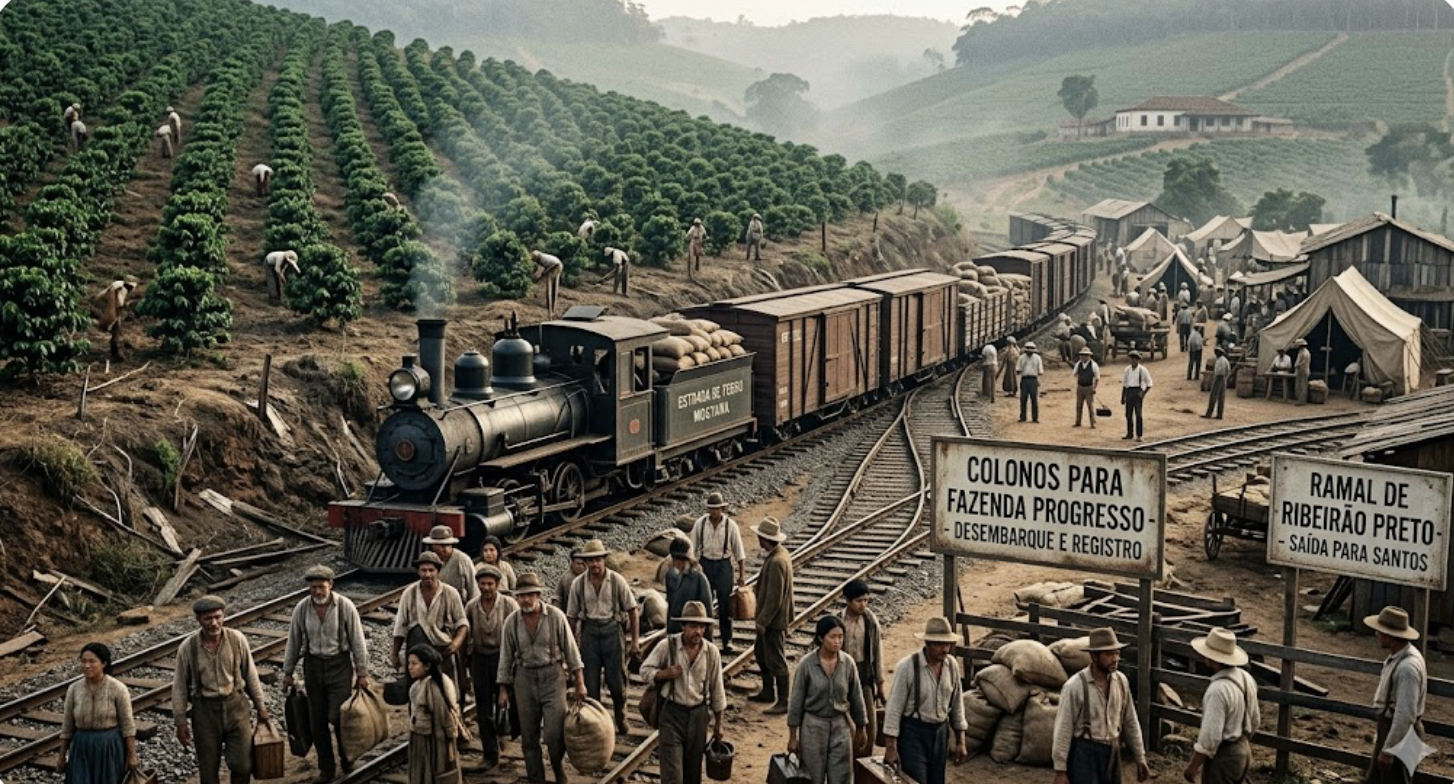
State action replaced slave labor.
Why This Shift Still Matters Today.
Brazil’s late-19th-century transformation matters today because it shows how states can redirect labor and capital under hard constraints. In São Paulo, coffee output doubled while slavery collapsed, but the system did not fail. It reorganized. The binding constraints were the sudden loss of coerced labor, limited access to land, and volatile foreign finance. The response tied state-subsidized immigration to hybrid wage contracts and railways backed by guarantees that shifted risk to the public. The core conclusion is simple. Coordinated state action linked labor, transport, and exports into a self-reinforcing growth loop. This blog explains what changed, what drove it, and what the state did.
How the Economy Was Reworked.
Coffee Pulled Capital into São Paulo.
Between 1870 and 1905, São Paulo expanded physical, financial, and human capital around coffee exports. Railway mileage pushed inland through the São Paulo Railway, Paulista, and Mogiana systems. These lines linked frontier land to the port of Santos. Coffee exports rose from roughly 3.5-4.2 million bags in the 1870s to more than 11 million by 1901-1905. That increase signaled a much larger flow of capital through the system. Financial flows depended heavily on British capital and sovereign borrowing. That dependence later destabilized the economy during the Encilhamento crisis and led to the 1898 Funding Loan. Human capital also shifted sharply. Between 1884 and 1920, millions of immigrants entered São Paulo, and the state subsidized more than 60 percent of them.
This reconfiguration created a tightly linked system. Export taxes funded immigration subsidies. Immigrant labor expanded coffee output. Higher output then supported more infrastructure. State-subsidized immigration was the hinge. Paired with rail investment, it opened new land and scaled production.
New Labor Rules Replaced Slavery.
Institutions changed as Brazil moved from slave labor to wage contracts. The parceria model failed. It relied on debt peonage and collapsed amid conflict and fraud. The colonato system replaced it with a hybrid wage framework. It mixed fixed wages, piece rates, and subsistence rights. That design aligned incentives while avoiding debt bondage.
Fiscal Power Backed the New System.
Firm organization and market structures also shifted. Export houses, mainly British and German, dominated trade. Domestic comissários supplied working capital to planters. The 1891 Constitution decentralized fiscal authority, allowing São Paulo to tax exports and fund immigration and railways directly. However, property rights stayed weak. The 1850 Land Law aimed to enforce a capitalist land market, but enforcement was poor.
These institutional changes did not broaden access. Land stayed concentrated. Contract design and weak land access kept immigrants tied to farm labor.
Growth Brought Instability and Unequal Power.
The transformation changed social order and exposed the economy to new cycles. Abolition in 1888 ended the old labor hierarchy. That forced elites to align around wage labor and immigration. Political power was then consolidated into oligarchic coalitions, especially the “coffee with milk” alliance between São Paulo and Minas Gerais.
Mobility Increased, But Risk Also Grew.
Labor relations became more mobile, but they stayed unequal. Between 40 and 60 percent of colonato workers changed plantations each year. That suggests both flexibility and instability. Boom-bust cycles also intensified. The Encilhamento bubble collapsed in 1891, and overproduction pushed coffee prices down in the late 1890s. External shocks, including financial crises and capital flight, increased volatility.
The result was a system that expanded fast but stayed fragile. It depended on coffee exports and rested on unequal control over assets.
What Set the Change in Motion?
Experimentation Started Under New Pressure.
Variation increased sharply as new labor systems, financial instruments, and transport models emerged. Planters tried parceria, colonato, and wage piecework before settling on colonato. Railway finance also varied. Some lines relied on guaranteed returns, others on private concessions, and others on mixed foreign and domestic ownership.
Policy change drove much of this variation. The path toward abolition signaled that slavery would end, so planters had to test new ways to recruit labor and write contracts. The crisis also widened the range of experiments. Deregulated banking during the Encilhamento created new firms and financial practices, even though many failed.
Global Markets Then Forced Hard Choices.
Selection pressures intensified through global markets and financial constraints. Coffee exports faced international price competition, so planters had to meet profitability tests. Overproduction drove prices down. That selected against less efficient producers and forced adaptation.
Financial selection also tightened. Currency depreciation in the 1890s raised the real burden of foreign debt. That bankrupted weaker firms, including the Sorocabana railway. The 1898 Funding Loan stabilized the system through austerity, but it also cut domestic liquidity and removed weaker enterprises.
State-subsidized immigration lowered production costs. That helped competitive coffee producers survive under harsh global pressure.
Migration And Railways Spread the Model.
Diffusion accelerated through migration, trade, and state coordination. European immigrants brought agricultural skills and practices. That helped spread tools such as plows and cultivators. Railways also moved goods, ideas, and market access across the interior at greater speed.
Capital and knowledge moved through transnational networks. British finance supported railways and sovereign debt. Foreign export houses coordinated global trade. The state strengthened diffusion by organizing immigration logistics and contract matching through institutions such as the Hospedaria.
This system increased mobility and integration across labor, goods, and finance. That helped the coffee economy scale quickly.
How The State Built the System.
The Government Tied Labor, Land, and Exports.
The state gave the system strategic direction by linking labor supply, land access, and export growth. Gradual abolition laws signaled that slavery would end. That forced elites to align around wage labor. The state then shaped markets through immigration policy and railway concessions. Those choices set the terms of production and trade.
Coalition building was also critical. The “Governors’ Policy” created a stable alliance that backed export-led growth and fiscal autonomy. São Paulo then taxed coffee to fund immigration. That fiscal-export loop tied public revenue to labor supply and growth.
Public Spending Lowered Key Production Costs.
Public investment focused on transport and labor supply. Railway guarantees shifted risk to the public and lowered risk for private investors. That helped the rail network expand quickly. The state also financed immigration by paying transatlantic passage and building processing capacity, such as the Hospedaria.
These interventions lowered factor costs and increased system capacity. However, public investment was selective. The state did not fund land redistribution or broad rural services. That choice reinforced inequality.
Subsidized immigration and rail infrastructure formed the backbone of the export system.
Crisis Response Stabilized but Narrowed Options.
The state changed policy during crises, but it often reacted late. Expansionary monetary policy during the Encilhamento raised activity. It also created instability and inflation. After the crash, the state shifted to austerity under the Funding Loan. That stabilized the currency, but it also deepened the recession.
Risk management also reached commodity markets. The 1906 Taubaté Agreement stabilized prices through stockpiling. That shifted risk from planters to the state and foreign lenders.
However, the state did not address the core structural risks. It did not diversify the economy or broaden asset ownership. That left the system exposed to commodity cycles.
What Policymakers Should Take from This.
Start With the Binding Constraint.
First, binding constraints matter more than abstract strategy. Brazil faced a labor collapse after the abolition of slavery. It responded with immigration, contract design, and infrastructure. That sequence mattered because labor came before expansion.
Fiscal Autonomy Can Build Productive Capacity.
Second, fiscal autonomy can unlock growth when it is tied to a productive sector. São Paulo used export taxes to finance labor recruitment and railways. That created a reinforcing loop. However, the same model can deepen regional inequality if governance is weak.
Risk Sharing Can Speed Investment Fast.
Third, socializing risk can accelerate investment. Railway guarantees and immigration subsidies quickly expanded capacity. But they also increased exposure to external debt and price swings.
Weak Institutions Leave Lasting Inequality Behind.
Fourth, institutional incompleteness shapes outcomes. The state did not enforce land reform or integrate freed workers. That left structural inequality in place even as output grew.
Stability Requires More Than Crisis Control.
Finally, adaptive governance must balance expansion and stability. Brazil moved from financial liberalization to austerity, and that stabilized the system at a high cost. The deeper lesson returns to the same constraint. State-subsidized immigration helped replace slave labor and drive coffee growth, but it could not fix narrow asset ownership or export dependence. That is the bottom line.


Leave a Reply