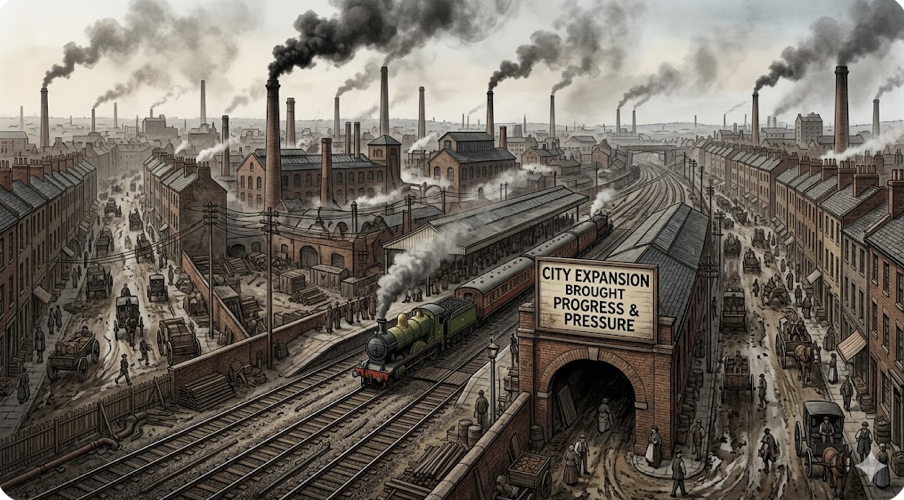
Railway lines spread across Britain in the 1840s. They changed how goods, workers, and capital moved. Industrial production rose between 1840 and 1860. Cities such as Manchester and Glasgow grew fast. City growth outpaced basic services. Repeated disease outbreaks turned sanitation into a public issue. By the late 1840s, epidemics and concern over living conditions helped push Britain toward its first national public health framework.
Economic expansion created strong pressures across society. Production and investment rose quickly. New industries and railways helped drive that change. However, living conditions in growing cities worsened, and financial markets became unstable. The commercial crisis of 1847 exposed those strains. The period, therefore, combined rapid growth with rising demands for stability and better outcomes for workers.
The key challenge was not to stop growth. It was to manage it better. Rising flows of energy, capital, and labor drove Britain’s transformation. Yet social conditions did not improve at once. The 1851 census shows how quickly society was changing. It expanded birthplace reporting to the parish and county. That gave the state a better view of where people came from and how communities were changing. The analysis that follows explains what changed, how it happened, and how the state responded.
Growth brought uneven results.
Industrial production and investment expanded sharply during this period. Railways changed transport and linked regions more closely. They made it easier to move goods and people at scale. Capital flowed into new ventures, especially railway companies. That shift raised economic activity but also encouraged speculation. Cities also grew fast as workers moved into industrial centers. Population density rose, and the pace of change became hard to ignore.
Financial systems changed in ways that increased instability. Railway Mania in the mid-1840s pulled large sums into speculative ventures. New financial instruments and company structures spread quickly. Oversight and reporting often remained weak. Historians disagree over how much directors were to blame. When expectations collapsed, the crisis of 1847 exposed deeper weaknesses. Credit tightened, firms failed, and the state stepped in to preserve stability. Even as output rose, major wage series show real earnings lagging productivity.
Social conditions worsened even as the economy grew. Rapid urbanization led to overcrowding, poor sanitation, and increased exposure to disease. Workers faced long hours, low security, and limited wage gains. These conditions sit at the center of the standard-of-living debate. Optimists point to later gains in wages and consumption. Pessimists stress stagnant real wages, the loss of older ways of life, and severe urban hardship. Evidence on working-class families shows only modest gains into the 1850s. Feinstein also highlights worsening or stalled health outcomes during the urban squeeze. That included rising infant mortality in urban parishes in the early to mid-nineteenth century.
Public health crises made those conditions impossible to ignore. The Public Health Act of 1848 reflected growing concern about urban life. Rapid growth brought visible gains, but it also deepened pressure and inequality. The 1851 census added details on the parish and county of birth. That shows the state treating migration and population movement as central facts to measure.
Growth ran on energy and movement.
How growth worked.
Britain’s transformation changed how energy, capital, and labor moved through the economy. Cheap coal and steam power let firms replace labor with machines. That helped them expand production at scale. Historians disagree on why Britain gained this edge. Robert Allen points to high wages and cheap coal. Others place greater weight on skilled artisans, human capital, and practical experimentation. Capital from earlier activities was reallocated to transport and manufacturing. Labor also moved from rural areas into industrial cities. These flows helped the economy grow faster than before.
Policy shifts also shaped the path of growth. The repeal of the Corn Laws in 1846 lowered food prices. That increased purchasing power for many workers. It also shifted the balance between agriculture and industry. At the same time, financial expansion funded major infrastructure projects. However, weak oversight and speculation created boom-and-bust cycles. Beneath rail and factory investment sat a deeper energy shift. Britain relied more on stored fossil energy than on the annual limits of organic fuels. Historians also disagree on how decisive coal was. Some treat cheap coal as central. Others place greater weight on broader productivity gains.
New technologies and institutions reinforced these changes over time. Railways moved goods, widened markets, and drew in more investment. Energy, transport, and production became more tightly linked. In the mid-century, the transport system relied heavily on railways and steamships, which became major consumers of coal. That tied energy extraction to mobility and market integration. It made the national scale easier to reach, but it also concentrated risk in dense industrial areas. These feedback loops accelerated growth and increased vulnerability. The system adapted gradually rather than through central planning.
The state responded step by step.
Public health and crisis response.
The state played a limited but changing role in this period. It repealed the Corn Laws, lowered food prices, and supported industrial growth. That decision changed incentives across sectors. It also contributed to long-term structural change. Yet the state did not fully direct investment into new industries. Markets still drove most expansion. However, policy choices increasingly shaped who gained and who lost.
The Public Health Act of 1848 created a national framework for sanitary reform, but it came with clear limits. The Act established a Central Board of Health with limited powers and no funding. It also relied heavily on local uptake rather than automatic enforcement. Where death rates rose above 23 per 1,000, local boards of health had to be established. Local authorities could borrow for infrastructure and repay through local rates. The design mattered because it recognized a public problem without forcing a uniform solution. This push followed intense concern about sanitation and cholera. Reformers linked living conditions to disease and life expectancy.
The state also responded to financial crises. In 1847, authorities allowed intervention to prevent a wider collapse. This intervention marked an early recognition that markets could fail at a systemic level. At the same time, weak oversight during the railway boom exposed a need for better regulation. Institutional change followed instability rather than preventing it. The state adapted step by step in response to pressure.
Managing growth shaped long-term results.
Managing growth, not just creating it, became the central challenge in this period. Britain achieved rapid industrial expansion. It also faced severe social and financial strain. Output growth alone did not improve living conditions. Over time, policy and institutions began to address some of these imbalances.
Three points explain why outcomes diverged. First, visible changes show that growth increased activity but also raised social strain. Second, deeper mechanisms show that flows of energy, capital, and labor drove expansion while amplifying risk. Third, state action shows that the government responded to problems step by step rather than trying to get ahead of them. Together, these points explain why rapid transformation produced uneven results. The system changed through pressure, feedback, and adjustment. The lesson still matters. Rapid growth can strengthen an economy. It can also create instability and inequality when it is poorly managed. Better coordination across infrastructure, public health, and finance can reduce those risks. Without that, workers and cities bear high costs. Long-term results depend on how societies manage the transition, not only on how fast they grow.


Leave a Reply