Early rules locked Panama out of the canal rents.
Panama hosted growth without broad gains.
Panama became an independent state in 1903 and hosted the world’s most strategic transport artery between 1914 and 1945. Yet it was unable to turn that position into a broad domestic transformation. One reason stands out: the Canal Zone commissary system. Through that system, rents flowed through Panama while bypassing Panamanian firms, workers, and the state. This case is not about missed geographical opportunities. Instead, it concerns rules, instruments, and power fixed early, then adjusted too late. The text traces what changed, why it changed, how the state shaped the result, and what that record means for Latin American and Caribbean policymakers today.
Canal growth reshaped Panama unevenly.
Shipping gains bypassed domestic incomes.
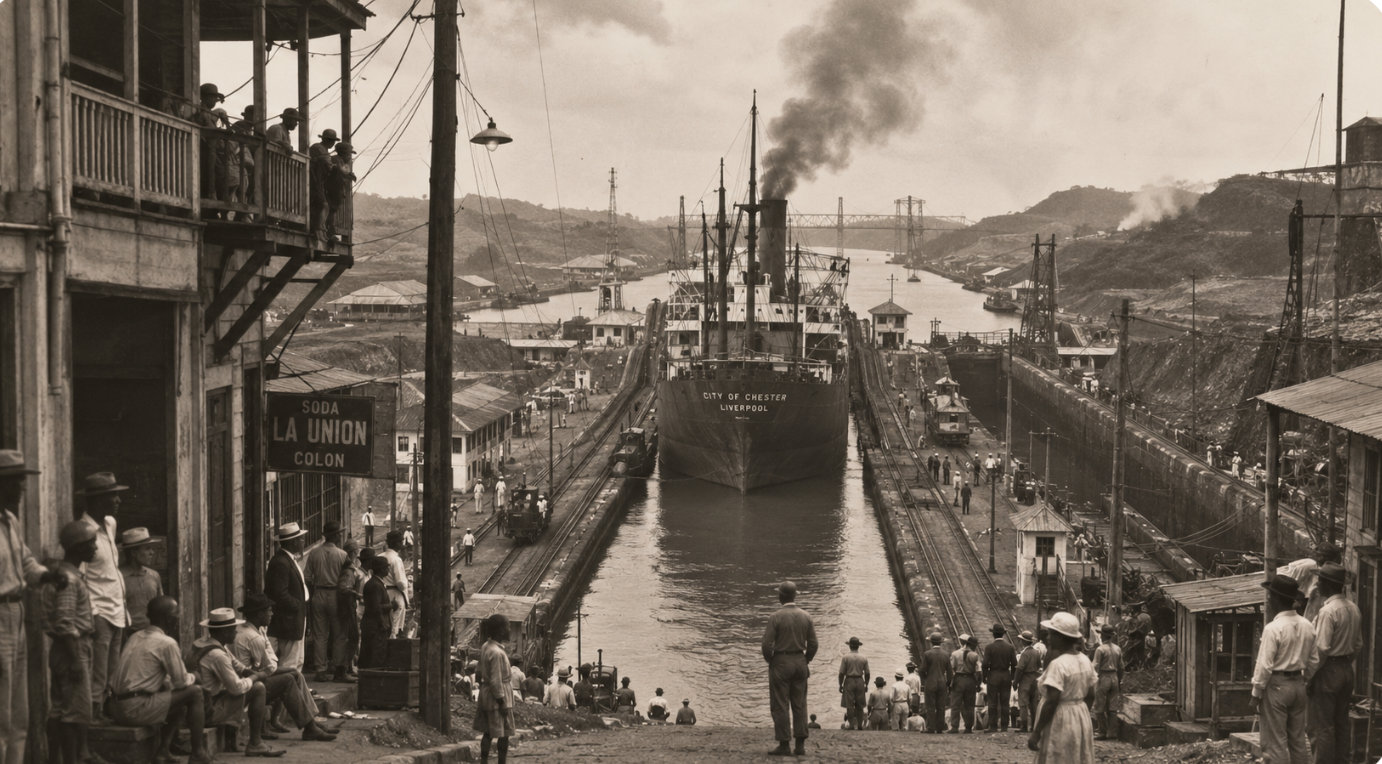
The canal reordered world shipping. It cut the maritime distance between the United States’ West and East coasts by 51 percent and halved key freight costs, including for lumber from Portland to New York. Yet those gains did not become broad Panamanian income. By the 1920s, the canal toll revenue was comparable to Panama’s entire annual state revenue, but very little of it went directly to the Panamanian state. The economic effect of the canal was less than that of earlier transport booms, including the 1850s railway boom. The canal generated massive value globally; however, Panama captured little of it at home.
Labor and production also shifted toward the canal corridor. Direct canal employment averaged 12,852 workers between 1921 and 1937, or 7 percent of the active population. During World War II, that share rose to 12.5 percent of the workforce. No manufacturing base formed around that labor. Instead, the corridor absorbed people and commerce while the interior thinned out. For example, from 1940 to mid-1941, 4,399 workers left Bocas del Toro for the Canal Zone.
Labor and urban space shifted to the corridor.
Urban space and public health also changed. The Canal Zone displaced residents and pushed them into Panama City and Colón, where landlords extracted high rents from crowded, unsanitary tenements. Inside the corridor, militarized sanitation cut death rates in Colón from 52 to 17 per 1,000. Beyond the corridor, the housing crisis deepened. The canal also remade the environment. The artificial lake and lock system created a permanent risk of water shortage. Panama changed fast; meanwhile, the pattern of change remained narrow, uneven, and centered on the canal enclave.
Law and treaty design determined the gains.
Treaties assigned rents before operations began.
The main reason why Panama failed to benefit was the legal allocation backed by the canal enclave design. The 1903 treaty granted the United States quasi-sovereign control over the Canal Zone in perpetuity and barred Panama from taxing the Zone, its firms, and its workers. The 1904 monetary arrangement dollarized the economy and removed an independent monetary tool. Those rules did not just shape later outcomes. They assigned the main rents before the canal opened. The Canal Zone commissary system then made that allocation visible in daily commerce by monopolizing the supply of goods to ships and workers, preventing Panamanian merchants from competing.
Three mechanisms kept Panama outside.
First, the provisioning ban and commissary monopoly blocked domestic firms from serving transit demand. Panamanian merchants could not provision ships, while tax-free commissaries sold goods directly inside the Zone. Second, finance worked against domestic capacity. The 10-million-dollar indemnity paid by the United States to Panama under the treaty earned 3.9 percent under J.P. Morgan custody, while Panama borrowed at 5.2 to 6.3 percent and paid 6 percent on sanitation works. As a result, this shifted fiscal space away from the Panamanian state.
Third, labor segregation subsidized operations. The two-tier payroll and status system – the Gold and Silver Roll system – paid West Indian and local labor in devalued silver while reserving better wages and benefits for Gold Roll, mainly US citizens and skilled workers.
External shocks changed the tempo, not the underlying rule. The 1915 closure, the Great Depression, and World War II each altered demand and investment. Wartime spending raised output and pushed the Canal Zone to 21 percent of gross domestic product (GDP) by 1945. However, the boom did not change the enclave story. It showed that strategic relevance could increase activity without changing who captured the main gains.
The United States built and policed the enclave.
The United States ran a command economy.
The United States directly shaped the market within the Canal Zone. It ran a command economy with state-controlled housing, utilities, hospitals, retail, and toll setting. It banned private homeownership and kept the state as landlord. The commissary system was central to that design. It kept commerce, profits, and supply chains inside the enclave. The United States also made large public investments in infrastructure, sanitation, and wartime defense works, but it limited risk by charging Panama for key services and preserving control over the main fiscal levers.
Panama negotiated only at the margins.
The Panamanian state operated at the margins. Its fiscal base hovered between 6 and 9 million dollars, and a US-imposed fiscal agent constrained its room to maneuver. State capacity deepened mainly in customs, ports, and treaty negotiation – all associated with the canal. Therefore, Panama could shape frictions around the enclave more than it could shape the enclave itself. The state did attempt adaptive governance through diplomacy. The 1933 reform circular restricted commissary sales, and the 1935 liquor order routed trade through Panama, doubling the cost per case. The 1936 Hull-Alfaro treaty also broke the commissary monopoly and ended US eminent domain over external lands.
Those gains mattered, but they remained marginal because Panama lacked a productive sector and did not attach strong conversion instruments to the rents that leaked back. There was an early discussion of a produce-accumulation agency, but it did not come with clear conditions. In that sense, the state could renegotiate access at the edge of the enclave, but it could not redirect the broader path. Even so, some domestic winners still emerged. Urban commercial elites and landlords captured what leaked, while the interior and Silver Roll laborers bore the losses.
Latin America should negotiate earlier.
Early terms decide later options.
The first lesson is about constraint. When a host country grants jurisdiction, taxation, and provisioning rights away at the start, later growth near the asset does not guarantee domestic transformation. Panama shows that point with unusual clarity. The Canal Zone commissary system captured commerce before it reached domestic firms, and later reforms recovered only a narrow slice of those rents.
For current Latin American and Caribbean (LAC) countries negotiating around ports, logistics corridors, energy projects, or digital infrastructure, the sequencing issue is plain. Write the capture rule into the original instrument, because leverage falls sharply after operations begin.
Capacity determines what states can keep.
The second lesson is about domestic capacity. Early rule-setting is necessary but not sufficient. Panama could not capture much even when rules loosened because its fiscal base was thin, its productive sector was weak, and its policy tools were narrow. That sequence matters. A country that secures royalties or fees but lacks customs strength, supplier development, or a disciplined conversion mechanism may still get enclave growth without structural change.
The trade-off is real. Dollarization brought stability after earlier monetary disorder, but it also removed a policy instrument and deepened dependence on external finance. The third lesson is political. Panama was not a unitary loser. Urban elites and landlords captured gains that leaked from the enclave, while peripheral regions and subordinated labor absorbed the costs. That distributional split can stabilize a weak model for a long time. Therefore, LAC policymakers should look past headline growth around strategic assets and ask three concrete questions in sequence: who can tax, who can provision, and who can convert temporary rents into domestic capability before path dependence hardens. Panama’s record suggests that waiting for later renegotiation is usually too late.


Leave a Reply